
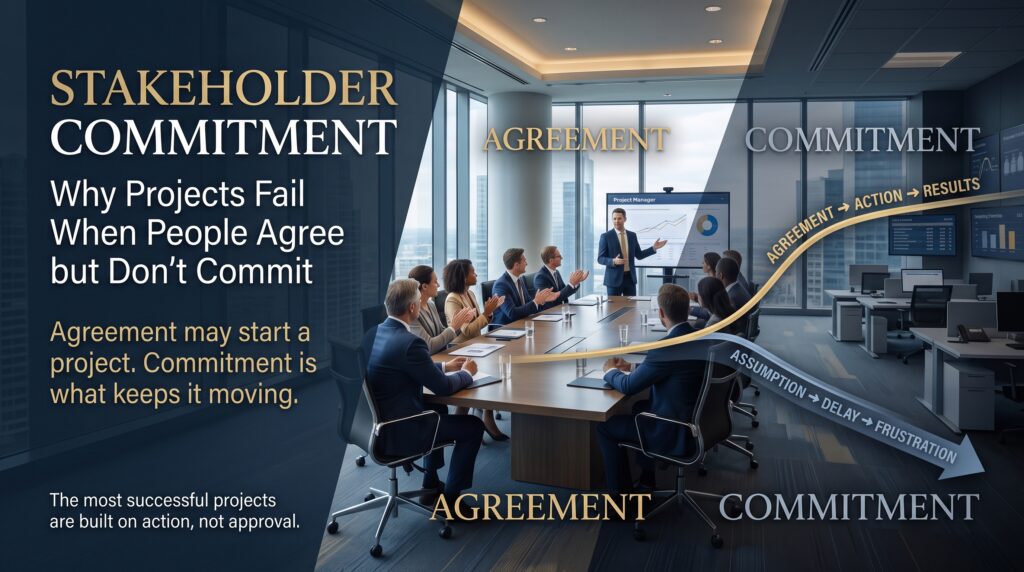

Stakeholder commitment is the missing ingredient behind a surprising number of struggling projects. Everyone nods in the kick-off meeting. The sponsor says “absolutely”. The business lead says “we’re fully behind this”. Then the first deadline arrives, the right people haven’t made time, key decisions are still sitting in someone’s inbox, and the project quietly starts to drift.
Nobody lied. They agreed, sincerely. But agreement is cheap and commitment is expensive, and projects run on the expensive one. We call this the commitment economy: a simple idea that every project spends commitment, in the form of time, attention, decisions and political backing, and runs into trouble when it’s overdrawn. This guide explains how to spot the gap and close it.
What Is the Commitment Economy in Projects?
Think of a project as a business with a budget in two currencies. The first is money, which everyone tracks. The second is commitment, which almost nobody tracks. Each task needs someone to say “I’ll do this, by then, and I’ll give up something else to make it happen”.
When that second currency runs short, the symptoms look like other problems. Deadlines slip. Scope expands. Meetings multiply. Teams blame unclear requirements or poor tools. Often the real issue is simpler: people agreed to the project but never truly committed to it. Strong stakeholder commitment turns agreement into action.
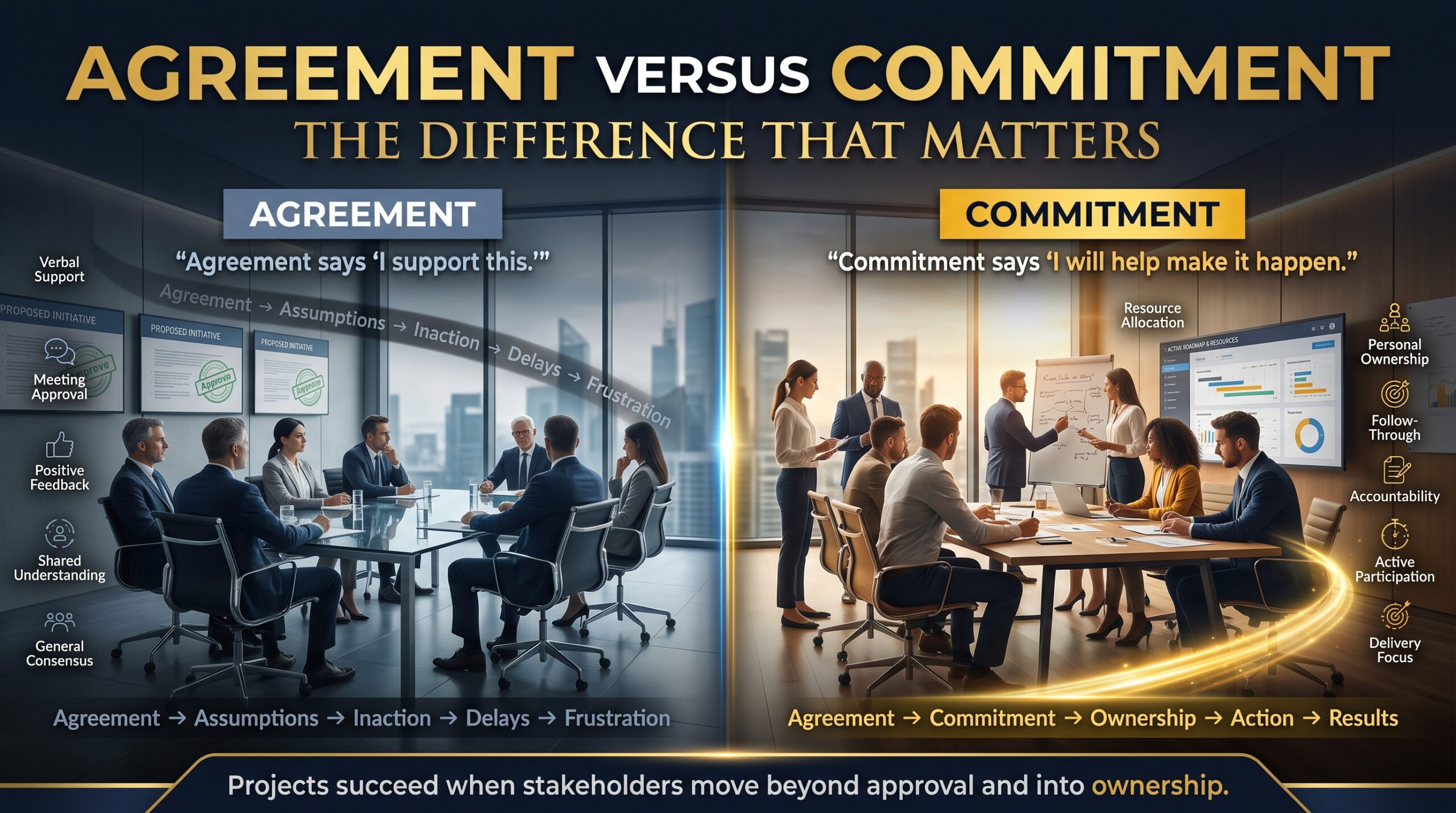
Agreement Versus Commitment: The Difference That Matters
These two words are used as if they mean the same thing. In practice, they behave very differently.
| Agreement | Commitment | |
| What it sounds like | “Sounds good.” “I’m supportive.” | “I’ll own this, and here’s what I’ll stop doing.” |
| Cost to the person | Almost nothing | Time, reputation and trade-offs |
| Evidence | Words in a meeting | Calendar time, decisions and named ownership |
| When pressure rises | Quietly fades | Holds, or is renegotiated openly |
| Effect on the project | Creates false confidence | Creates dependable momentum |
The risk is that agreement looks exactly like commitment in a status report. Both show up as green. Only one survives the first real obstacle.
Why Stakeholder Commitment Breaks Down
People rarely withhold commitment out of bad intent. It usually fades for ordinary, predictable reasons:
- Competing priorities. Everyone has a day job. A new project gets agreement because refusing feels unreasonable, but nothing else is taken off the plate.
- Unclear ownership. When a task belongs to “the team”, it belongs to nobody. People assume someone else will pick it up.
- Decisions without consequences. If no one is waiting on a decision, there’s no pressure to make it.
- Fear of saying no. Many professionals would rather agree now and fail quietly later than be seen as unhelpful.
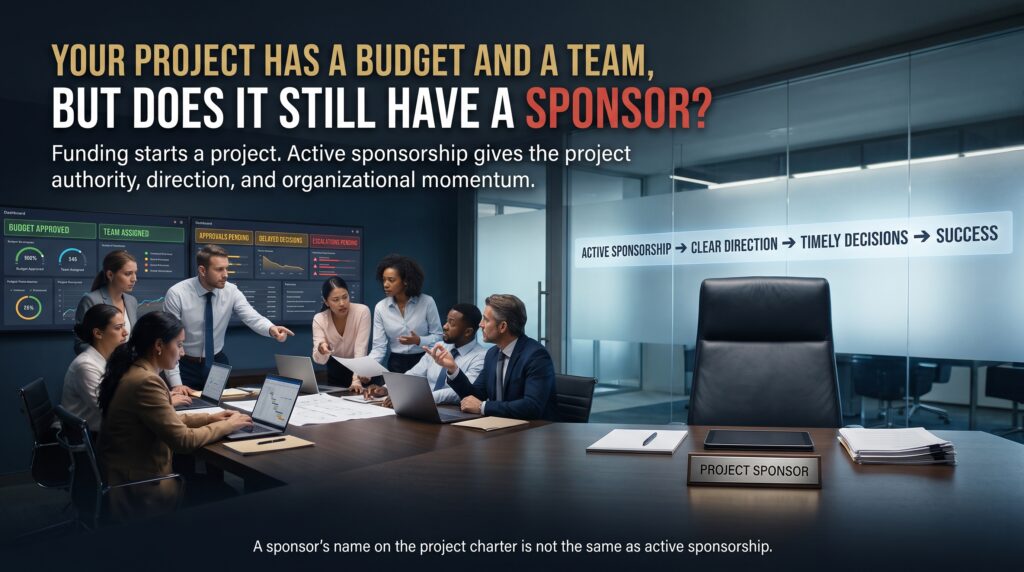
- Distant sponsors. When the executive sponsor appears only at the start and end, teams read the project as optional.
Each cause is human, which is why stakeholder commitment is a skill to be practised and why strong project management training focuses on behaviour as much as methods.
Warning Signs of Fake Agreement
You can often see weak stakeholder commitment weeks before a project visibly fails. Watch for these signs:
- Key stakeholders send delegates to meetings and the delegates can’t make decisions
- Action items are assigned to groups rather than named individuals
- The same decision appears on three consecutive agendas
- People say “yes” quickly but no one blocks out calendar time
- Updates are positive in meetings and worried in private messages
- The sponsor can’t explain the project’s trade-offs in plain language
If you spot three or more, it’s worth a direct conversation, even if the dashboard still says green.
The Hidden Cost of Agreement Without Commitment
The cost rarely arrives as a single dramatic failure. It shows up as rework, delay and tired teams. People build things that are later changed. Decisions get reversed because the right person wasn’t really involved the first time. Delivery teams lose trust in leadership, and leadership loses visibility into what’s happening.
Over time, the project’s best people start to protect themselves. They commit to less, document more and avoid taking risks. The project may still finish, but it finishes slowly, expensively and without much goodwill. That’s the real price of weak stakeholder commitment.
Who Owns Stakeholder Commitment? Sponsor, Manager and Team
A common trap is assuming the project manager alone is responsible for commitment. In reality, each role carries a different piece of it, and the project works best when everyone knows which piece is theirs.
| Role | What commitment looks like | What a gap looks like |
| Executive sponsor | Removes blockers, backs trade-offs and makes timely decisions | Appears only at kick-off and sign-off |
| Business stakeholders | Give real time for requirements, reviews and testing | Send delegates who can’t decide |
| Project manager | Asks for specific commitments and tracks them openly | Accepts vague support and reports green |
| Delivery team | Commits to realistic work and flags risks early | Over-promises, then stays quiet |
Here’s a simple example. A retail business launches a new ordering system. The operations manager agrees enthusiastically but never schedules time for testing. Two weeks before go-live, the project manager discovers that nobody from operations has validated a single workflow. The launch slips by a month. No one acted in bad faith, yet the absence of real stakeholder commitment cost the business weeks of delay and a lot of goodwill.
The lesson isn’t to demand more promises. It’s to turn each promise into something visible and specific, such as a booked testing window, before the work begins.
How to Build Stakeholder Commitment From Day One
Commitment can be designed. The most effective project managers don’t just ask for support. They create situations where support has to become specific. These habits make the biggest difference:
- Ask for a specific commitment. Replace “Are you on board?” with “Can you give two hours a week and make the final call on scope?”
- Name one owner per outcome. Shared ownership sounds collaborative but usually delays decisions.
- Surface the trade-off. Ask what each stakeholder will pause or drop to make room. If the answer is “nothing”, commitment isn’t real yet.
- Make commitments visible. Record them in a charter or RACI that everyone can see. Visibility creates gentle accountability.
- Start small and early. A first, achievable commitment, such as a decision by Friday, builds the habit for larger ones.
- Check in on commitments, not just tasks. Ask “Is this still realistic for you?” before something slips, not after.
These practices are central to the Agile approaches taught in our AgilePM Foundation course, where roles, collaboration and empowered decision-making are built into the framework.
How Agile Project Management Strengthens Commitment
Agile project management makes commitment hard to fake. Short timeboxes force teams to commit to a realistic amount of work. Prioritisation methods such as MoSCoW make people choose what matters most instead of agreeing to everything. Regular reviews keep sponsors close enough to the work to make timely decisions.
That doesn’t mean Agile removes the problem. A team can still go through the motions. But a well-run Agile project gives you frequent, low-cost chances to notice when commitment is slipping and correct it. If you want to apply these methods in real environments, explore the AgilePM Practitioner course, which focuses on practical application and governance.
A 30-60-90 Day Plan to Rebuild Commitment on a Struggling Project
First 30 days: Hold one-to-one conversations with each key stakeholder. Ask what they can genuinely give, what they’re worried about and what they would need to stop doing. Then reset the plan around real capacity.
Days 31 to 60: Assign a single named owner to every deliverable and decision. Put decision deadlines in the calendar, and share who is waiting on whom.
Days 61 to 90: Introduce a short, regular review where stakeholders confirm or renegotiate commitments openly. Treat a renegotiation as a healthy sign, not a failure.
Notice there’s no big programme here. It’s about clarity, honesty and rhythm.
Stakeholder Commitment Across Australian Cities
The principles hold everywhere, but the pressure points vary with each city’s industries.
Sydney: Large finance and technology programmes depend on many senior stakeholders with competing agendas. See project management courses in Sydney.
Melbourne: Healthcare, education and state government projects often involve long approval chains. Explore project management courses in Melbourne.
Brisbane: Construction, infrastructure and resources projects rely on tight coordination between contractors and sponsors. Check project management courses in Brisbane.
Perth: Remote operations and mining projects make regular, clear commitments especially important. Learn about project management courses in Perth.
Adelaide: Defence, health and advanced manufacturing projects need disciplined governance and clear ownership. Visit project management courses in Adelaide.
Canberra: Government programmes have layered accountability, which makes explicit sponsor commitment critical. View project management courses in Canberra.
Prefer to study from anywhere? Our locations page covers live online options for the whole country.
Common Mistakes When Trying to Fix Stakeholder Commitment
- Relying on enthusiasm. Energy in a kick-off meeting fades. Specific commitments last.
- Over-escalating. Rushing to the sponsor for every gap erodes trust. Start with a direct, respectful conversation.
- Treating renegotiation as failure. An honest “I can’t do that” is far better than a silent miss.
- Skipping the conversation about trade-offs. If nothing is being given up, nothing is truly committed.
- Assuming training isn’t needed. Many project managers learn influence and accountability techniques on the job, which is slow and costly. Browse our project management courses to build these skills deliberately.
Frequently Asked Questions About Stakeholder Commitment
What is stakeholder commitment in project management?
It’s the willingness of sponsors, business leaders and team members to give real time, decisions and support to a project, not just to say they agree with it.
Why do projects fail even when everyone agrees?
Agreement is easy to give and doesn’t cost anything. Without specific ownership, time and trade-offs, people’s other priorities quietly win, and the project slows down.
How do you measure stakeholder commitment?
Look at behaviour: attendance by decision-makers, calendar time set aside, speed of decisions, named owners for actions and willingness to renegotiate openly.
Can Agile help with low stakeholder commitment?
It can help, because timeboxes, prioritisation and frequent reviews make gaps visible early. It still depends on people using those tools honestly.
Where can I study project management online in Australia?
Project Management Courses Online offers AgilePM Foundation and AgilePM Practitioner training with live online delivery and city options. See the courses page or contact our team.
Final Thoughts: Commit First, Then Deliver
Projects rarely fail because nobody agreed. They fail because agreement was mistaken for commitment, and nobody noticed until it was too late. The fix isn’t more meetings. It’s better questions, clearer ownership and honest conversations about what people can truly give.
Ready to build the skills to lead those conversations? Explore our project management courses, or call 1300 649 299 to speak with a course advisor.