
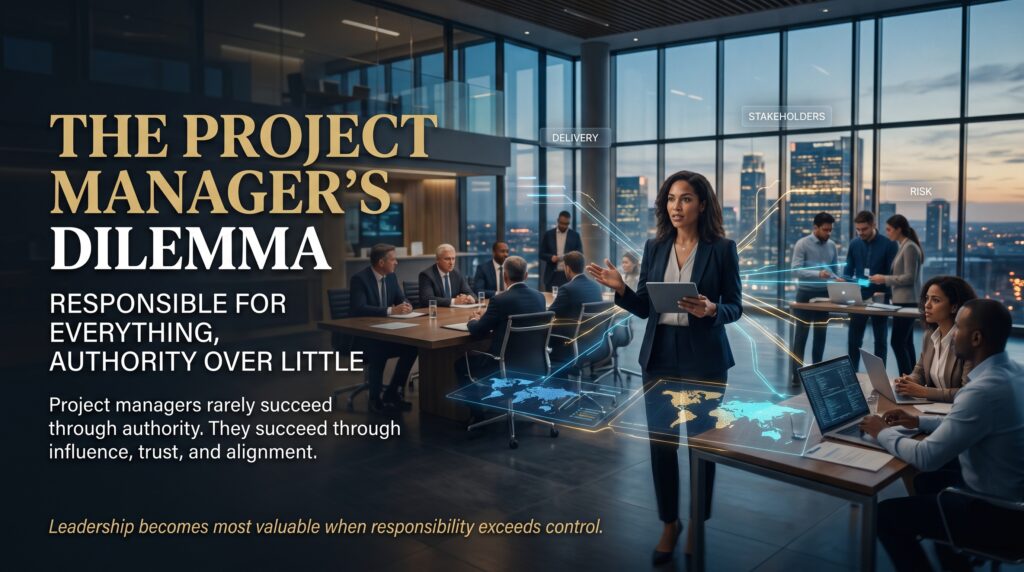
Responsibility without authority is the defining tension of modern project management. You are expected to deliver on time, on budget and to a high standard, yet the people, money and decisions you depend on often sit with someone else. If you have ever chased a team member who does not report to you, waited weeks for a sponsor decision, or been blamed for a delay you could not control, you already know this dilemma well.
The good news is that the project managers who thrive are rarely the ones with the biggest titles. They are the ones who learn to lead through clarity, relationships and good structure. In this guide, we explain why responsibility without authority exists, what it costs your projects and career, and eight practical ways to build real influence, even when your formal power is limited.
Key Takeaways
- Responsibility without authority is common: most project managers carry full accountability but control little of the budget, people or scope.
- The gap comes from how organisations are structured, not from personal failure.
- You can close the gap with a strong charter, clear decision rights, stakeholder mapping and honest reporting.
- Formal training in methods such as AgilePM gives you the language and frameworks to negotiate authority.
What Is the Project Manager’s Dilemma?
The project manager’s dilemma is simple to state and hard to live with. It is responsibility without authority: you are held accountable for outcomes, but you rarely hold the levers that create those outcomes. The developers, engineers, analysts or tradespeople doing the work usually report to functional managers. The budget belongs to a sponsor or finance team. Scope changes are demanded by senior stakeholders. Yet when the project slips, the project manager is the first name in the room.
This is not a sign that you are doing something wrong. It is a built-in feature of how most organisations run projects. The Project Management Institute (PMI) has long described structures such as functional, matrix and projectised organisations, and in the common matrix management model, authority is deliberately shared between functional managers and project managers. In a weak matrix, the project manager acts more like a coordinator than a decision-maker. Responsibility without authority is the natural result.
Why Responsibility Without Authority Happens: Accountable for Everything, Control Over Little
Understanding the root causes of responsibility without authority helps you respond strategically instead of emotionally. Here are the five most common reasons the gap appears.
1. Team members report to someone else
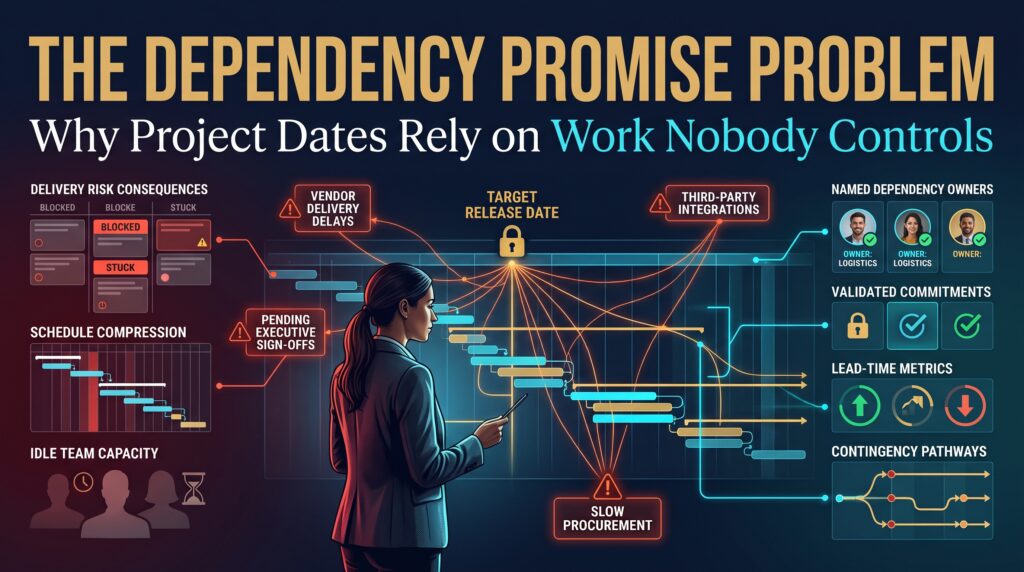
In matrix and shared-resource environments, your team members answer to their line managers for performance reviews, promotions and priorities. You can ask for their time, but you cannot direct it. When their line manager changes their workload, your schedule suffers.
2. The budget is held higher up
Many project managers monitor spending but cannot approve it. Every variation, tool purchase or contractor request has to travel up the chain, adding delays that the project manager still has to explain.
3. Scope is negotiated by other people
Senior stakeholders, customers and executives often shape scope in meetings the project manager is not invited to. By the time the change reaches the team, it arrives as an instruction, not a conversation.
4. The role itself is poorly defined
In some organisations, “project manager” is a title without a mandate. There is no written charter, no clear decision rights and no agreed escalation path. When nothing is written down, authority defaults to whoever has the highest seniority.
5. Governance is slow or unclear
Steering committees that meet monthly cannot support projects that change weekly. When decisions wait for the next meeting, the project manager absorbs the delay and the pressure.
The Real Cost of Responsibility Without Authority
Ignoring this gap is expensive. Research from the Project Management Institute consistently highlights weak sponsorship, unclear objectives and poor communication among the leading causes of project failure. Each of those problems is made worse when the person accountable for delivery cannot make or influence the decisions that matter.
- Schedule slippage: waiting on approvals and resources you do not control.
- Scope creep: without authority to say “no” or “not yet,” change requests pile up.
- Stress and burnout: carrying accountability without control is a recipe for exhaustion.
- Blame culture: the project manager becomes the convenient explanation for every setback.
- Talent loss: capable project managers leave for organisations that let them lead.
Naming the costs of responsibility without authority matters because it gives you evidence to use in conversations with sponsors. You are not complaining. You are describing a business risk.
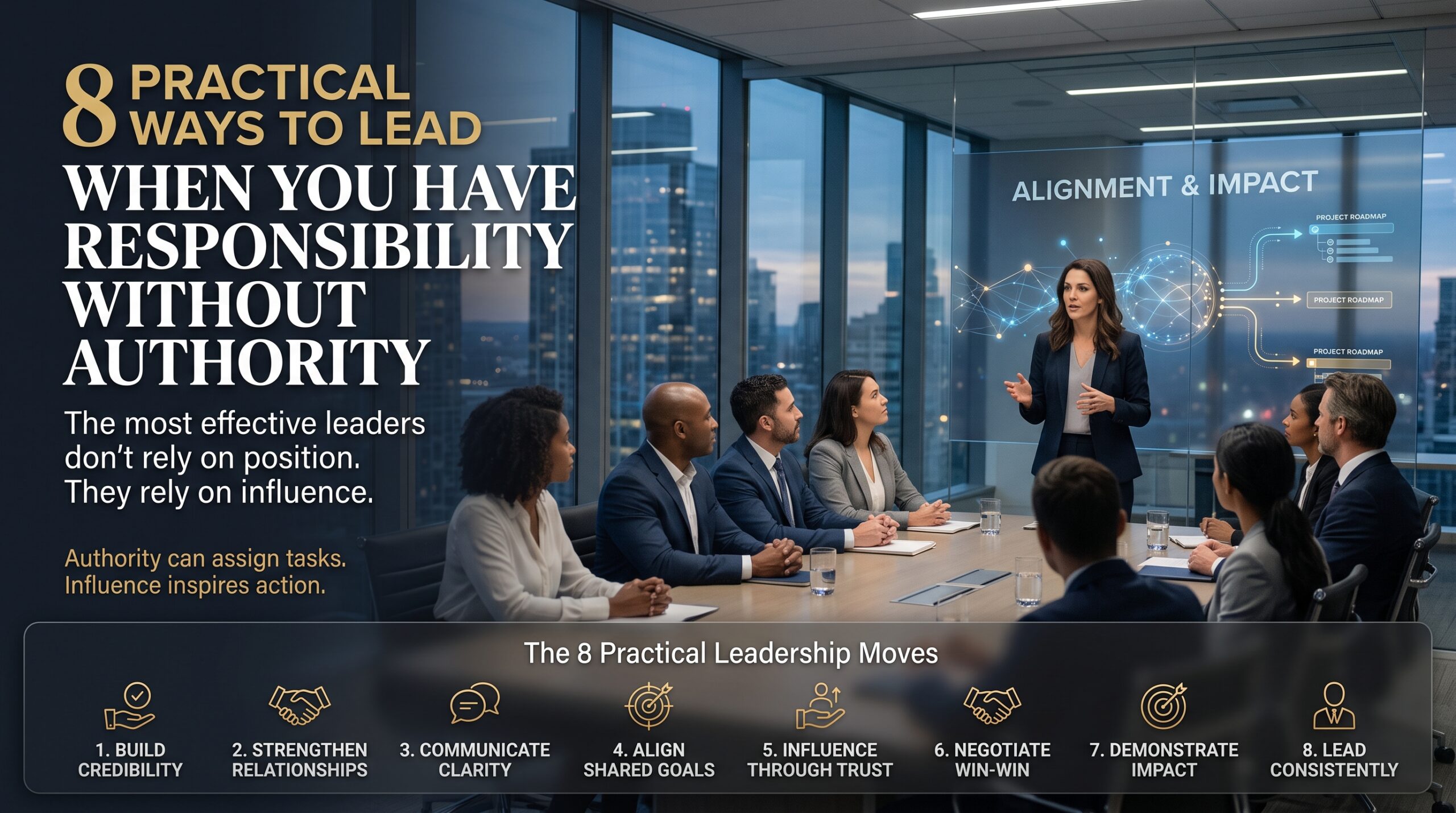
8 Practical Ways to Lead When You Have Responsibility Without Authority

1. Get a clear project charter signed
A project charter is your most important source of formal authority. It names the sponsor, states the objectives, outlines scope and budget, and records what the project manager is permitted to decide. Even a one-page charter signed by a senior leader changes how people respond to your requests.
2. Define decision rights with a RACI chart
A RACI matrix clarifies who is Responsible, Accountable, Consulted and Informed for each task or decision. It removes guesswork and gives you something neutral to point to when roles blur. If you are accountable for an outcome, make sure you are also named as a decision-maker for the choices that affect it.
3. Build a genuine partnership with your sponsor
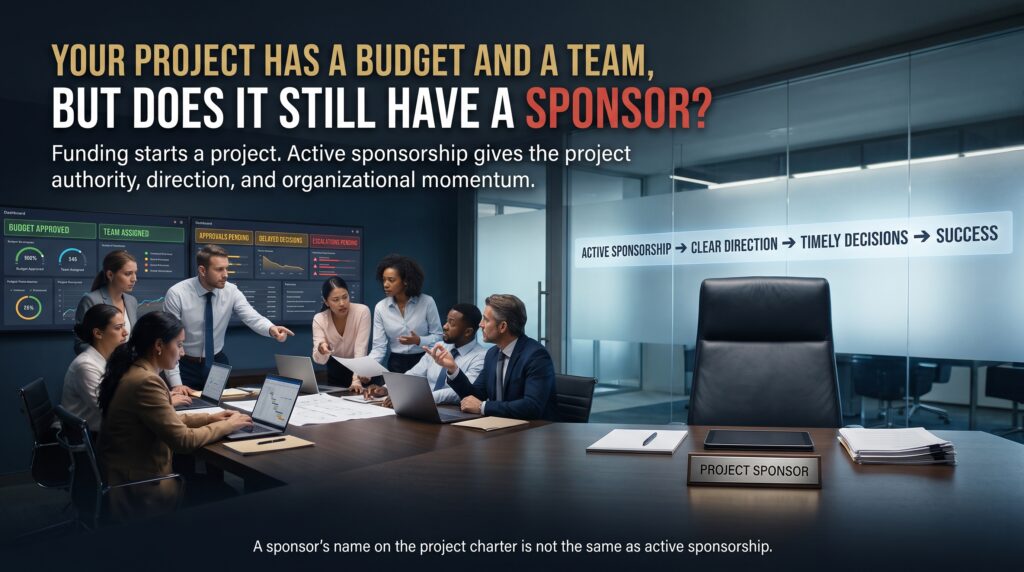
An engaged executive sponsor is the strongest antidote to responsibility without authority. Meet regularly, share bad news early and ask directly for the support you need, whether that is unblocking a resource, backing a scope decision or clearing a political obstacle.
4. Map your stakeholders and focus on influence
Not every stakeholder deserves the same attention. Use a power and interest grid to identify who can help or hinder your project, then plan how you will engage each group. In their well-known book, Influence Without Authority, Allan Cohen and David Bradford describe how professionals can build influence by understanding what others value and offering something in return. That principle is as useful today as ever.
5. Negotiate resources before the project starts
Agree who will work on the project, for how many hours and for how long, before kick-off. Get written commitment from line managers. It is far easier to negotiate resources at the start than to argue for them halfway through a crisis.
6. Let data do the talking
When you cannot command, you can inform. Clear dashboards, risk registers and variance reports make problems visible and difficult to ignore. A simple statement such as “This delay has moved our go-live by three weeks, and we need a decision by Friday” is far more persuasive than a general complaint.
7. Set up a clear escalation path
Agree in advance how and when issues will be escalated, and to whom. Escalation is not failure. It is a normal governance tool that protects the project and protects you.
8. Develop your influencing and negotiation skills
Listening, framing, credibility and reciprocity are learnable skills. Robert Cialdini’s research on influence highlights principles such as reciprocity, consistency and social proof, which project managers use daily without always realising it. Invest in them deliberately.
Can Agile Help With Responsibility Without Authority?
Agile approaches do not magically remove responsibility without authority, but they do make roles and decision rights more explicit. Frameworks such as AgilePM, developed by the Agile Business Consortium, define clear roles, responsibilities and governance so that decisions are made close to the work and by the right people. Short iterations also create frequent checkpoints, which means issues surface early rather than at the end of the project.
If you are new to this approach, our AgilePM Foundation course is a strong starting point. It introduces the principles, roles and lifecycle of Agile project delivery. If you already have foundation knowledge and want to apply it with confidence in real projects, the AgilePM Practitioner course builds on that base with practical implementation skills.
How Project Management Training Closes the Responsibility Without Authority Gap
Experience teaches a great deal, but structured training gives you a shared vocabulary that senior stakeholders recognise. When you can talk confidently about governance, risk, stakeholder engagement, business cases and methodologies such as Agile or PRINCE2, you earn credibility that titles alone cannot provide. The Australian Institute of Project Management (AIPM) also offers professional standards and community resources for practitioners across the country.
Our project management courses online cover the full project lifecycle: initiation, planning, execution, monitoring and closure. Learners build practical skills in scheduling, budgeting, risk management, stakeholder communication and team leadership, with flexible options for working professionals. You can also read our FAQs to see how enrolment, timings and delivery work, or contact our team for course advice.
Responsibility Without Authority Across Australian Cities
The challenge of responsibility without authority looks slightly different depending on where and how you work. Whether you manage projects in Sydney, Melbourne, Brisbane, Adelaide, Perth or Canberra, flexible training makes it easier to learn without stepping away from your job. Explore options on our Locations page or choose your city below.
- Sydney: fast-moving finance, technology and professional services projects with many stakeholders. See project management courses in Sydney.
- Melbourne: a strong mix of construction, IT, healthcare and education projects. See project management courses in Melbourne.
- Brisbane: infrastructure, resources and events projects with complex supplier networks. See project management courses in Brisbane.
- Adelaide: growing defence, health and manufacturing sectors. See project management courses in Adelaide.
- Perth: resources, engineering and energy projects with strict governance. See project management courses in Perth.
- Canberra: government programs where formal governance and clear accountability are essential. See project management courses in Canberra.
A Quick Self-Check: How Wide Is Your Responsibility Without Authority Gap?
Answer these questions honestly about your current project:
- Do I have a signed charter or written mandate?
- Do I know exactly which decisions I can make without approval?
- Do my team members’ line managers support the time commitments?
- Do I have regular access to my sponsor?
- Is there an agreed escalation path for blocked decisions?
Every “no” shows where responsibility without authority is likely to hurt you. Start with the answer that is easiest to fix, usually the charter or the escalation path, and work from there.
Frequently Asked Questions About Responsibility Without Authority
What does responsibility without authority mean for a project manager?
It means being accountable for project results while lacking formal control over the team, budget or key decisions. It is common in matrix organisations where resources report to functional managers.
Why do project managers have so little authority?
Organisational structure is the main reason. Team members often report to line managers, budgets are held by sponsors, and scope is set by senior stakeholders, which leaves the project manager coordinating rather than commanding.
How can a project manager lead without formal authority?
Focus on influence: secure a clear charter, define decision rights, build a strong sponsor relationship, map stakeholders, negotiate resources early and use data to make issues visible.
Does Agile solve the authority problem?
Agile frameworks such as AgilePM clarify roles and decision-making, which helps. They work best when the organisation also supports empowered teams and engaged sponsors.
Which course is best for learning to manage stakeholders and governance?
A structured course covering the full project lifecycle is ideal. For Agile delivery, AgilePM Foundation is a good starting point and AgilePM Practitioner suits those ready to apply the method in practice.
Can I study project management online from Adelaide, Perth or Canberra?
Yes. Live virtual and online options let you study from anywhere in Australia while keeping up with work and family commitments.
Final Thoughts: Turn the Dilemma Into Leadership
Responsibility without authority will not disappear from project work, but it does not have to define your experience. The most effective project managers treat it as a leadership test: they clarify roles, build alliances, communicate with evidence and keep learning. Each of those habits increases your influence, one conversation at a time.
If you are ready to build the skills and credibility to overcome responsibility without authority, browse our project management courses or get in touch to find the right fit. We support learners across Sydney, Melbourne, Brisbane, Adelaide, Perth and Canberra, and online.