


Benefits realisation is the part of a project that nobody celebrates and almost nobody owns. The system goes live on time. The steering committee thanks the team, the project manager closes the books and the celebratory email goes out. Six months later, someone asks what happened to the savings promised in the business case, and the room goes quiet. The project delivered. The value didn’t arrive.
This is the benefits ownership gap, and it’s one of the most expensive blind spots in Australian project delivery. It rarely appears in a status report, because the project is officially finished and green. Yet the investment only pays off if the business changes how it works and captures the benefits it was promised. This guide explains why project value disappears after go-live, who should own it, and how project managers, sponsors and business leaders can close the gap and improve benefits realisation.
What Is Benefits Realisation?
Benefits realisation is the practice of making sure the benefits promised by a project are actually delivered, measured and sustained after the project ends. The discipline is often called benefits realisation management, and it covers everything from defining benefits in the business case to tracking them long after the project team has moved on.
The easiest way to understand it is to separate three things that are often confused:
| Term | What it means | Example: a new customer system |
| Output | What the project delivers. | The new system is built, tested and live. |
| Outcome | The change in how people work as a result. | Staff record every customer interaction in the system. |
| Benefit | The measurable value the business gains. | Faster response times, fewer lost enquiries and higher repeat sales. |
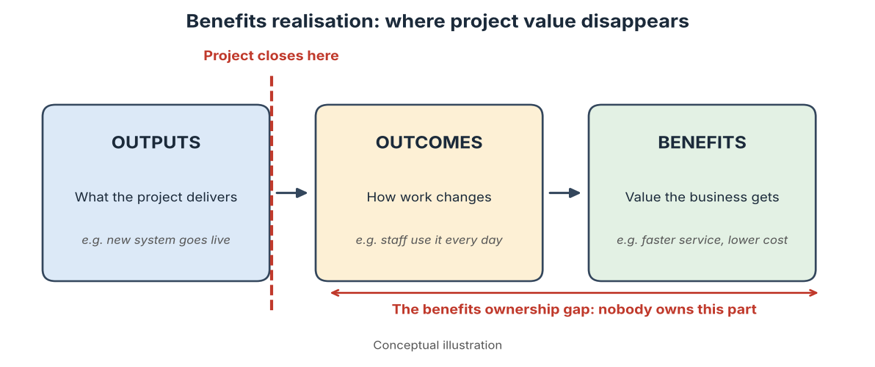
Projects are usually run to deliver outputs. Businesses invest to get benefits. The gap between the two is where value gets lost, because delivering an output doesn’t guarantee an outcome, and an outcome doesn’t guarantee a benefit unless somebody keeps checking.
The Benefits Ownership Gap: Where Project Value Disappears
Think about who does what. The sponsor promises benefits in the business case. The project team delivers the outputs. The business is supposed to turn those outputs into outcomes and benefits. But when the project closes, the team is disbanded and the sponsor’s attention moves to the next priority. The people who made the promise and the people who built the solution are gone, and the business is left with a new system and no clear owner for the value.
That is the benefits ownership gap. Everybody agrees the benefits matter, but nobody is accountable for them once delivery ends. As a result, benefits realisation quietly stops at go-live, just when it should start.
Why Project Value Disappears After Go-Live
In most cases, lost value traces back to a handful of recurring causes.
1. The project closes when delivery ends
Traditional governance ties the end of a project to the delivery of its outputs. Once the deliverables are signed off, the project is closed and the budget, team and reporting disappear. But the benefits often take months to appear, long after governance has stopped looking.
2. Benefits belong to the business, but the project manages them
A project manager can deliver a system, but they can’t make a department change how it works. Only business leaders can do that. When benefits are left in the project’s hands, they have no owner in the part of the organisation that must change.
3. Benefits were never defined clearly
Phrases like “improved efficiency” or “better customer experience” sound good in a business case, but they can’t be measured. Without a baseline, a target and a date, nobody can say whether the benefit has been achieved.
4. The business case was optimistic and never revisited
Business cases are written to win funding. Benefits are sometimes inflated, or based on assumptions that changed long before go-live. If the case is never updated, the final result is judged against a promise that was never realistic.
5. People didn’t adopt the change
A system nobody uses properly delivers nothing. If staff keep their old spreadsheets or workarounds, the outcome never happens and the benefits stay on paper.
6. Nobody tracks it
Once reporting stops, benefits realisation becomes invisible. Without regular measurement, early signs of problems go unnoticed and nobody is prompted to act.
7. Savings never leave the budget
A project may claim that it will save 500 hours a year. But unless a manager actually removes cost, reallocates the time or increases output, the saving doesn’t become a real financial benefit. It simply disappears into the day-to-day workload.
8. Benefits sit across several departments
One department often pays for a project while another receives the benefits. Without a shared view, nobody is accountable for the whole picture and nobody is motivated to make the change happen.
The Real Cost of Lost Benefits
When benefits realisation fails, the cost goes beyond the original budget:
- Wasted investment. The organisation pays for a capability it doesn’t fully use.
- Reduced credibility. Sponsors and project teams lose trust when promised results don’t appear.
- Inflated business cases. Because teams know benefits are never checked, there’s little discipline in what gets promised.
- Repeated mistakes. Without honest reviews, the same weaknesses carry into the next project.
- Zombie systems. Tools remain in place, partly used, costing licences and support without delivering value.
- Change fatigue. Staff become cynical when projects arrive with fanfare and then fade.
The Australian National Audit Office (ANAO) regularly examines how public sector investments are managed, and government bodies such as the Digital Transformation Agency publish expectations for managing large digital investments. Private sector organisations face the same underlying question: did we get what we paid for?
Warning Signs Your Benefits Realisation Is Failing
- The project is declared a success, but nobody can show the promised business results.
- Benefits in the business case are vague, such as “improved efficiency” with no number.
- Nobody outside the project team is named as responsible for benefits.
- Project governance ends at go-live, with no scheduled benefits review afterwards.
- Users still rely on old tools and workarounds months after launch.
- Claimed savings never show up in a budget or forecast.
How to Improve Benefits Realisation: A Practical Plan
Better benefits realisation starts long before go-live and continues long after it. Here is a step-by-step approach that works for most organisations:
- Start with outcomes in the business case. Describe the change in behaviour or performance the project is meant to create, not just the deliverables.
- Define each benefit properly. For every benefit, record what will be measured, the starting baseline, the target, the date and the owner.
- Name benefit owners in the business. Each benefit needs an accountable manager in the part of the organisation that will realise it. The project manager supports them but doesn’t own the result.
- Build a benefits register. Keep one place that lists all benefits, their measures, owners and status, and link each benefit to the project outputs that enable it.
- Plan for adoption. Include training, communication, new procedures and manager support in the plan, because benefits only arrive when people work differently.
- Fund and resource the period after go-live. Budget for stabilisation, support and benefits tracking, so the work doesn’t depend on goodwill.
- Hand over benefits formally. At project closure, transfer responsibility for benefits tracking to the business owners, with clear dates for review.
- Schedule benefits reviews. Set reviews at regular intervals after go-live, such as a few months, six months and a year, and report results to the sponsor.
- Turn savings into real budget changes. If a benefit is a cost saving, agree who will remove the cost or redeploy the capacity, and when.
- Learn and feed it forward. Use what you find to improve the next business case and the next project.
A Simple Benefits Register Example
A benefits register doesn’t need to be complicated. This illustrative layout shows the key fields:
| Benefit | Measure | Baseline | Target | Owner | Review |
| Faster customer response | Average hours to first reply | 24 hours | 8 hours | Head of Service | Month 6 |
| Reduced manual data entry | Staff hours per week | 120 | 40 | Operations Manager | Month 3 |
| Fewer lost enquiries | Enquiries without follow-up | 15% | 5% | Sales Manager | Month 6 |
The numbers above are examples only. The point is that each benefit has a clear measure, a starting point, a target, a named owner and a date to check.
Benefits Realisation Across Common Project Frameworks
Most major project and programme frameworks recognise the problem, even if they use different language:
- PRINCE2 includes benefits management and benefits review planning, so benefits can be checked after the project ends.
- Managing Successful Programmes (MSP) treats benefits management as a central part of running programmes of change.
- PMBOK from the Project Management Institute covers benefits management and value delivery as part of project governance.
- AgilePM, which is based on DSDM, is built around business need and delivering value early and often, rather than waiting until the end.
No framework solves the benefits realisation ownership problem on its own, though. They all depend on organisations actually assigning owners and keeping the review going after the project closes.
Post-Implementation Reviews and Benefits Reviews: What’s the Difference?
A post-implementation review looks back at how the project was delivered and what lessons can be learned. It usually happens soon after go-live. A benefits review looks at whether the promised value is arriving, and it needs to happen over a longer period, often more than once. Both are valuable, and they answer different questions. Our guide to post-implementation review best practices covers the first, while this article focuses on keeping benefits realisation alive after the review is done.
Benefits Realisation in Agile Projects
Agile approaches can help because they deliver working increments early, giving the business a chance to use the solution, learn and adjust before the end. Prioritising by business value, as techniques like MoSCoW do, also keeps attention on outcomes. But agile doesn’t remove the need for ownership of benefits realisation. If nobody is responsible for turning each increment into business results, an agile project can deliver a steady stream of features and still miss the benefits.
Project Management Skills That Protect Project Value
Strong benefits realisation depends on project professionals who can connect delivery to business results, work with senior stakeholders and keep value in view. Our courses include:
- AgilePM Foundation for a clear introduction to agile project management concepts, frameworks and best practice.
- AgilePM Practitioner for applying agile project management in real projects with control and governance.
You can see every option on our project management courses page. If you’re planning your next step, these articles may help: read about which project management certification to get, the role of a project manager, whether a diploma of project management is worth it in Australia and whether project management will be replaced by AI. The Australian Institute of Project Management also offers resources for local practitioners.
Project Management Courses Across Australia: Online and In Person
Learning together helps project teams share a common language for value and delivery. Training is available online and in selected cities. Find your location below:
- Project management courses in Melbourne, with a training location in West Melbourne.
- Project management courses in Sydney, with a training location in Surry Hills.
- Project management courses in Brisbane, with a training location in Brisbane City.
- Project management courses in Perth, available live online or in-house.
- Project management courses in Adelaide, available live online or in-house.
- Project management courses in Canberra, available live online or in-house.
You can also visit the locations page, learn more about us, read the FAQs, browse the blog, or contact our team on 1300 649 299 to find the right course for you or your team.
Frequently Asked Questions About Benefits Realisation
What is benefits realisation?
Benefits realisation is the process of making sure the benefits promised by a project are actually delivered, measured and sustained after the project ends. It connects project outputs to real business outcomes and value.
Who is responsible for benefits realisation?
Benefits should be owned by business leaders in the area that will gain the value, with the sponsor accountable overall. The project manager supports the process by defining, tracking and handing over benefits, but they can’t deliver business change alone.
What is the difference between outputs, outcomes and benefits?
Outputs are what a project delivers, such as a new system. Outcomes are the changes in how people work as a result. Benefits are the measurable value the business gains, such as saved time, lower costs or higher revenue.
What is a benefits register?
A benefits register is a document that lists each expected benefit, how it will be measured, its baseline and target, the person who owns it and when it will be reviewed. It keeps benefits visible after the project ends.
Why do projects fail to deliver benefits after go-live?
Common reasons include governance ending at project closure, unclear or unmeasurable benefits, no business owner, weak adoption of the change, optimistic business cases and no tracking after launch.
How long after go-live should benefits be reviewed?
It depends on the project, but benefits reviews should be scheduled in advance and repeated at sensible intervals, such as a few months, six months and a year after go-live. Some benefits take longer to appear and may need ongoing tracking.
Final Thoughts on Benefits Realisation
Delivering a project on time and on budget is an achievement, but it isn’t the goal. The goal is the value the project was meant to create. Benefits realisation closes the gap between delivery and results by giving that value a name, a measure and an owner who stays in place after the project team leaves.
If you’d like to build the skills to lead projects that deliver lasting value, explore our project management courses in Australia or speak with a course advisor today.