


The forecast credibility gap is the distance between the date a project team reports and the date that team actually believes. Everyone in the room can feel it. The status report says go-live is still the end of the quarter, the green light stays green, and yet the developers, the analysts and even the project manager have quietly stopped expecting that date to hold. Nobody lies out loud. The date just stays on the page because changing it feels harder than keeping it.
In Australian workplaces, where projects run across Sydney, Melbourne, Brisbane and beyond, this gap is one of the most expensive habits in delivery. Stakeholders make hiring, marketing and budget decisions on dates the team no longer trusts. This guide explains why the forecast credibility gap forms, how to recognise it in your own reporting, and how to close it without turning every status meeting into a confession.
What Is the Forecast Credibility Gap?
The forecast credibility gap appears when official project forecasts, such as the finish date, the budget at completion or the next milestone, no longer match the private judgement of the people doing the work. The report keeps saying one thing while the team’s real expectation moves in another direction, usually later and usually more slowly than anyone admits.
It is different from a plain delay. A delay is a fact that has been reported. The forecast credibility gap is a delay that has been noticed by the team but not yet reported. Because the reported date has not changed, sponsors and customers carry on planning around it, and the eventual correction arrives as a shock instead of a gradual adjustment.
Think of a weather app that keeps showing sunshine while you stand outside holding an umbrella. Each refresh is technically an update, but you stop trusting it. Project forecasts that never move, even as the evidence changes, lose their audience in exactly the same way.
Why Project Teams Keep Reporting Dates They No Longer Believe
This is rarely about dishonesty. It is about incentives, habits and the way most reporting systems are designed. A handful of causes show up again and again.
Nobody wants to be the first to say it
Once a date has been announced to a steering committee, changing it means standing up and owning the bad news. Many project managers wait for one more week of progress, hoping the team will recover the time. The wait becomes a pattern, and the forecast credibility gap widens a little with every status cycle.
Green status is rewarded, amber is questioned
If every amber rating triggers extra meetings, extra reports and uncomfortable questions, teams learn to avoid amber. This is often called watermelon reporting: green on the outside, red on the inside. People are not hiding the truth for fun, they are protecting their time and their reputation.
The original date became a commitment
A forecast is meant to be an estimate that improves with evidence. In many organisations the first date quickly hardens into a promise. Once it is a promise, any honest revision feels like a broken one. This is closely related to the optimism we explored in the planning fallacy problem, where early timelines look realistic until real work begins.
Old assumptions are still holding the plan up
Dates depend on assumptions about supplier delivery, resource availability and scope stability. When those assumptions expire quietly, the date stays while its foundation disappears. Our article on project assumptions that expire shows how that happens.
Reporting tools reward updates, not honesty
Most project dashboards ask for a percent complete and a date. They rarely ask how confident the team feels. A system that cannot record doubt will not display it, so the forecast credibility gap stays invisible until something breaks.
A Simple Example of the Forecast Credibility Gap
Picture a mid-sized finance team in Sydney rolling out a new reporting platform. The plan targets go-live in eight weeks. In week three, a data migration problem appears. The team privately concludes the date is now unlikely, but the report stays green because a fix is being tried.
By week six, confidence among the team has fallen sharply, yet the status report still implies the date is safe. Only in week eight does the project manager announce a three-month slip. Stakeholders are furious, not because of the delay itself, but because they were never warned.
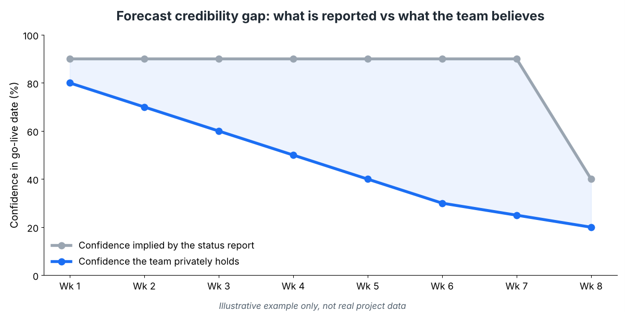
The shaded area in the chart is the forecast credibility gap. Its size, not just the final delay, tells you how much trust the project has already spent.
What the Forecast Credibility Gap Costs Your Organisation
A hidden gap between reported and believed dates does damage long before the final deadline is missed.
- Bad decisions downstream. Marketing launches, customer promises and hiring plans are locked in against a date nobody trusts.
- Lost sponsor trust. When a sponsor discovers that the team knew earlier, every future report is read with suspicion.
- Rushed recovery. Late corrections leave no room for sensible options such as reducing scope, so teams compress testing and quality suffers.
- Budget surprises. Longer schedules mean extra contractor and vendor costs that were never reserved.
- Team morale. Developers and analysts who are asked to defend a date they do not believe tend to disengage.
Signs You Have a Forecast Credibility Gap
You do not need a sophisticated tool to spot the symptoms. Listen for these patterns in your own project meetings.
- The finish date has not moved for months, even though scope has changed.
- Team members say things like “off the record, it will be later” after the meeting ends.
- Every status report is green until the final two weeks, then it jumps to red.
- Milestones are hit by redefining what done means rather than by finishing the work.
- Stakeholders have stopped asking about dates because they assume they are wrong.
If two or more of these sound familiar, there is a real forecast credibility gap to close. Decision delays often make it worse, so it is worth reading about the decision latency problem alongside this guide.
How to Close the Forecast Credibility Gap
The goal is not to produce perfect predictions. It is to make forecasts honest, frequent and safe to change. These steps work in most delivery environments, whether you run waterfall, hybrid or agile projects.
- Report a range, not a single date. Replace “30 June” with “between 30 June and 28 July, most likely 14 July”. A range tells readers how uncertain the work really is.
- Add a confidence rating. Ask the team each cycle how likely the date is on a simple scale. Record the answer next to the date.
- Separate the target from the forecast. The target is what the business wants. The forecast is what the evidence says. Show both, and treat the difference as useful information instead of failure.
- Use triggers to re-forecast. Do not wait for the monthly cycle. Re-forecast whenever scope changes, a key person leaves, a supplier slips or an assumption expires.
- Compare against similar past projects. Historical data on how long comparable work took is a powerful check against optimism. The Project Management Institute publishes extensive research and standards on this kind of delivery practice.
- Reward early warnings. When someone raises a risk to the date early, thank them publicly. People report what gets rewarded.
- Tie milestones to evidence. A milestone is complete only when a tested, demonstrable result exists, not when someone says it feels done.
- Review forecasts with fresh eyes. Ask someone outside the team to challenge the date once a month. Independent review catches what familiarity hides.
For a practical walkthrough of schedule forecasting methods, PM Study Circle has a useful overview of steps and best practices.
Should You Stop Reporting Fixed Dates Altogether?
No. Organisations still need dates to plan around, and contracts often demand them. The aim is to stop pretending a single date carries more certainty than it does. A good approach is to give two views: a committed date for external promises, which includes sensible contingency, and an honest forecast for internal steering.
- Use fixed dates where contracts or regulation require them.
- Show internal forecasts as ranges with a stated confidence level.
- Agree upfront what triggers a formal re-baseline so that changes feel routine, not dramatic.
Australian research on delivery performance reinforces the point that honest reporting matters. The Australian Institute of Project Management and its research partners publish material on how projects perform and how the profession is developing, which is worth reading if you want an industry view.
High-Intent Searches Related to the Forecast Credibility Gap
People who are living with this problem tend to search for practical answers, not theory. This table shows the kinds of phrases they use and where each one fits.
| Topic | Example search | Where it helps |
| Schedule forecasting | how to forecast project completion date | Core method for closing the gap |
| Status reporting | project status report template | Add confidence ratings and ranges |
| Watermelon reporting | green status but project failing | Spotting hidden risk |
| Earned value | earned value management Australia | Evidence-based progress |
| Risk and assumptions | project assumptions register | Finding expired assumptions |
| Agile forecasting | agile burn-up chart forecast | Probabilistic dates for sprints |
| Training | project management courses online Australia | Building team forecasting skills |
Terms such as project manager, steering committee, schedule baseline, risk register and stakeholder reporting are the entities search engines connect to this subject. Using them naturally helps readers and search engines understand exactly what the topic covers.
The Forecast Credibility Gap Across Australian Cities
The problem shows up everywhere, but the pressure behind it varies by city and industry. If your project teams work across several locations, training them to forecast honestly pays off in each one.
- Sydney: Fast-moving finance and technology projects with tight stakeholder scrutiny. See our project management courses in Sydney.
- Melbourne: Large infrastructure and government programs where one slipped date affects many contractors. Explore Melbourne.
- Brisbane: Growing construction and resources sectors with long supply chains. Learn about Brisbane
- Adelaide: Defence and manufacturing projects with strict reporting rules. See Adelaide.
- Perth: Mining and engineering programs with remote sites and long lead times. Check Perth.
- Canberra: Government projects with heavy governance and high public visibility. Explore Canberra.
You can see every location on our locations page, or contact us to arrange training for your team.
Build Forecasting Skills with Project Management Courses
Closing the forecast credibility gap is a skill, and skills are learned. Project managers who understand estimating, risk, governance and agile delivery are far better placed to report honest dates and defend them to sponsors. Our project management courses cover the practical tools teams need.
- The AgilePM Foundation course introduces agile project management principles, roles and the way flexible delivery handles change and uncertainty.
- The AgilePM Practitioner course builds on that with hands-on application of the approach to real projects.
- Our FAQs page answers common questions about formats, locations and booking, and you can learn more about us.
Browse the full list on our courses page or call 1300 649 299 to talk to the team.
Ad Copy for Project Management Training in Australia
Below is responsive search ad copy written for high-intent searches such as project management courses online Australia. Headlines stay within Google’s 30-character limit and descriptions within 90 characters.
Headlines
- Project Management Courses AU
- Learn Honest Forecasting
- AgilePM Foundation Training
- AgilePM Practitioner Course
- Live Online or In-House
- Train Your Project Team
- Sydney Melbourne Brisbane
- Enquire About Courses Today
Descriptions
- Build practical skills in planning, forecasting and reporting. Live online training.
- Help your team report dates they believe. Courses for Australian project managers.
- Sydney, Melbourne, Brisbane, Adelaide, Perth, Canberra. Call 1300 649 299 today.
Forecast Credibility Gap Checklist for Your Next Status Meeting
Use this short checklist before you send your next report.
- Does the finish date reflect what the team really expects?
- Is a range and confidence level shown beside the date?
- Have any assumptions behind the date expired or changed?
- Did anyone raise a concern off the record that belongs on the record?
- Are milestones backed by tested evidence?
- Is it clear what would trigger a re-forecast?
Frequently Asked Questions About the Forecast Credibility Gap
What is the forecast credibility gap in project management?
It is the difference between the dates a project reports and the dates the team privately believes, which erodes trust in reporting.
Why do project teams report dates they do not believe?
Common reasons include fear of delivering bad news, reward for green status, and a first date that hardened into a promise.
How can I forecast a project completion date more honestly?
Use ranges, record team confidence, compare with similar past projects and re-forecast whenever key assumptions change.
Is a project delay the same as a forecast credibility gap?
No. A delay is reported. The gap exists while a known delay stays unreported.
Can training reduce the forecast credibility gap?
Yes. Training in estimating, risk and agile delivery gives teams the confidence and the language to report realistic dates.
Close the Forecast Credibility Gap Before It Closes Your Project
A forecast is only useful if people believe it. When teams keep reporting dates they no longer trust, the real cost is not the slipped deadline but the slow loss of credibility that comes with it. Use ranges, record confidence, separate targets from forecasts and make early warnings safe, and the forecast credibility gap shrinks fast. Sponsors would rather hear a small truth today than a large one in eight weeks.
If you want your team to build these skills, get in touch, explore our courses, or read more on our blog. We train project professionals in Sydney, Melbourne, Brisbane, Adelaide, Perth and Canberra.