



The decision latency problem is the gap between the moment a project needs an answer and the moment someone actually gives it. A question that could be settled in ten minutes sits in an inbox for a fortnight. The team keeps asking, the sponsor keeps meaning to reply, and the schedule quietly slips while everyone stays busy.
This guide explains why the decision latency problem is so common, what it costs, and the practical changes project managers can make to speed things up without losing control. If your projects often feel stuck waiting for a yes, this is for you.
What Is the Decision Latency Problem?
In project management, delay is usually blamed on scope, resources or technology. The decision latency problem points somewhere else: the time lost between a question being raised and a decision being made. The actual thinking often takes minutes. The waiting takes weeks.
It is easy to miss because nothing looks broken. People are working, meetings are happening and updates are going out. But a handful of unresolved questions are holding up dozens of tasks behind them.
Why the Decision Latency Problem Happens
Slow decisions rarely come from laziness. They come from how organisations are set up:
- Nobody is sure who decides. When decision rights are unclear, everyone waits for someone else to own it.
- Too many approvers. Each extra reviewer adds waiting time, and every one of them can say no.
- Infrequent decision meetings. If the steering group meets monthly, a question raised the day after a meeting waits almost four weeks.
- Missing information. Decision makers are asked to choose without a clear summary of the options, costs and risks, so they ask for more detail.
- Fear of getting it wrong. In cultures that punish mistakes, people delay or escalate even small decisions.
- Busy sponsors. Senior people have full calendars, and project questions compete with everything else.
- Everything is treated as equally important. Small, reversible choices get the same heavy process as major ones.
Signs of the Decision Latency Problem
- The same open question appears in status reports week after week.
- Team members work on assumptions because the formal answer has not arrived.
- Decisions are made, then reopened by someone who was not in the room.
- Simple approvals are escalated to the most senior person available.
- Delivery dates slip even though tasks are being completed on time.
- People say “we are waiting on approval” more often than “we are building”.
The Real Cost of the Decision Latency Problem
Delay is never free, even when it is invisible in the budget.
- Idle or misdirected work. Teams either wait or build on guesses that may later need to be redone.
- Schedule slippage. One late decision pushes every dependent task, and the delay compounds.
- Higher costs. Contractors, tools and overheads keep running while the project waits.
- Lower morale. Capable people become frustrated when they cannot move forward.
- Lost opportunity. A late launch means lost benefits, and sometimes a lost market window.
- Weaker accountability. When nobody owns a decision, nobody owns its delay either.
In short, the decision latency problem is a hidden tax on every project it touches.
How to Fix the Decision Latency Problem
You do not need a new methodology to improve this. A few clear habits can shorten waiting times dramatically.
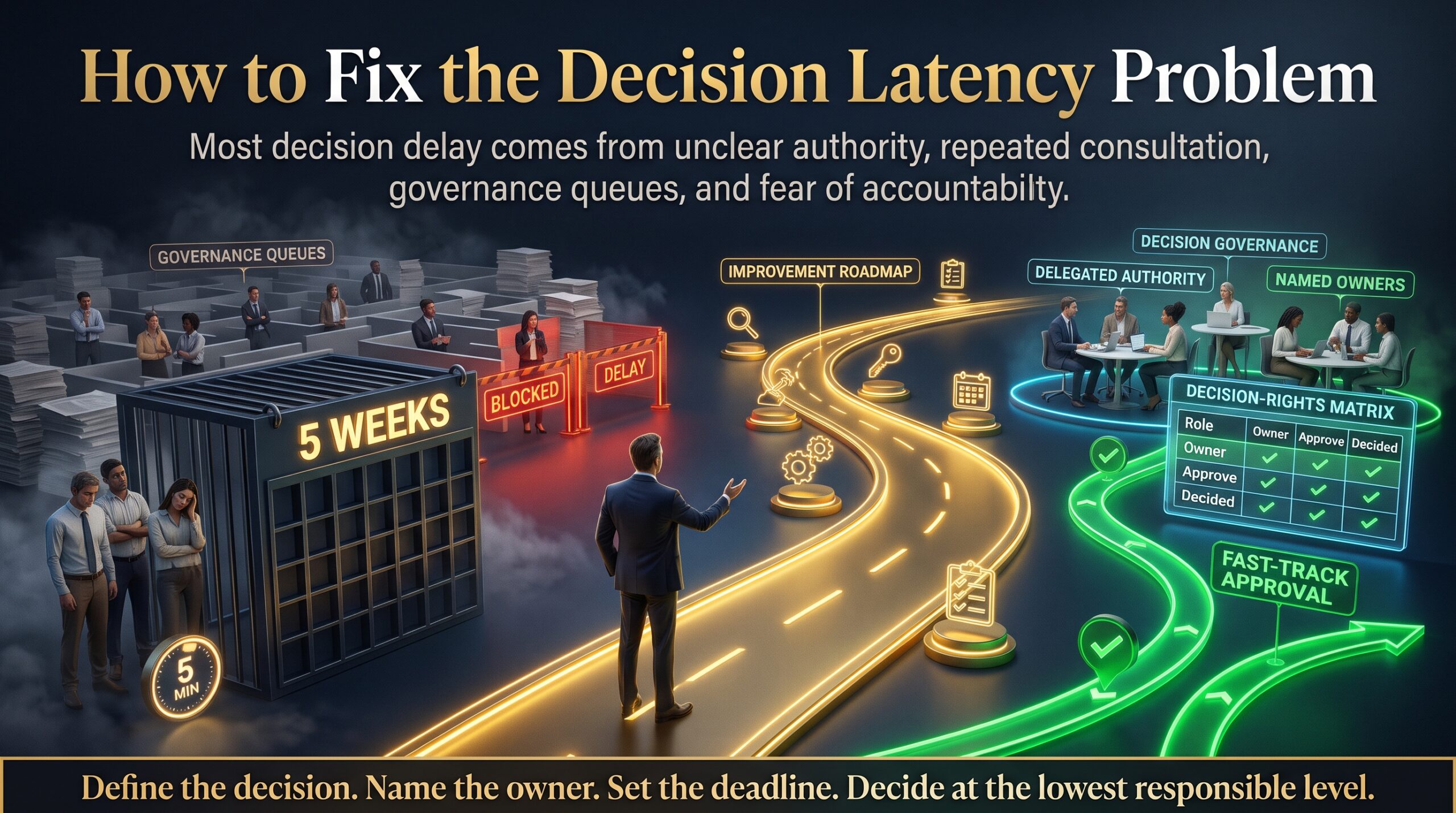
- Define decision rights up front. For each type of decision, name who decides, who advises and who is informed. A responsibility assignment matrix such as RACI, or a decision-focused version like DACI, makes this clear.
- Set tolerances and delegate. Agree limits for cost, time, scope and quality within which the project manager or team can decide without asking. Only exceptions go up.
- Separate big decisions from small ones. Treat easily reversed choices lightly and save the heavy process for decisions that are costly or hard to undo.
- Time-box every decision. Put a deadline on each open question and track it. Timeboxing turns an open-ended wait into a clear date.
- Agree a default. For lower-risk items, state that if there is no response by a certain date, the team proceeds with the recommended option.
- Make decisions easy to make. Send a short one-page summary with the question, options, a recommendation, the cost of waiting and the deadline.
- Keep a decision log. Record what was decided, by whom, when and why, so decisions stick and do not get reopened without a good reason.
- Create a fast lane. Use a short weekly decision slot, a chat channel or an on-call approver for urgent questions instead of waiting for the next big meeting.
- Define an escalation path. If a decision is not made by the deadline, everyone should know who it goes to next.
- Measure decision time. Track how long decisions take from question to answer, and review the slowest ones.
Agile approaches build many of these habits in by design. Frameworks derived from DSDM, including AgilePM, emphasise empowered teams, timeboxing and decisions made within agreed boundaries.
A Simple Decision Tracker
A short table is often all you need to make the decision latency problem visible. Review it in every project meeting:
| Decision needed | Decision owner | Raised | Due | Status |
| Choose software vendor | Sponsor | 1 Mar | 8 Mar | Overdue |
| Approve revised timeline | Project board | 3 Mar | 10 Mar | Due this week |
| Confirm test environment | Project manager | 5 Mar | 7 Mar | Decided |
| Sign off design option B | Product owner | 6 Mar | 13 Mar | Open |
Seeing the age of each open question is a powerful nudge. It shifts the conversation from “why is the project late?” to “what decision do we need today?”
Mistakes That Make the Decision Latency Problem Worse
- Sending every question to the most senior person instead of delegating within agreed limits.
- Adding approvers “just in case” without clarifying their role.
- Waiting for perfect information when a good-enough answer would do.
- Letting decisions float in email threads with no owner or deadline.
- Treating the delay as the sponsor’s problem instead of making the cost of waiting visible.
Project Management Skills That Speed Up Decisions
Faster decisions come from skills as much as systems: structuring options clearly, setting tolerances, engaging stakeholders and running short, focused governance. Our courses build these skills in a practical way:
- AgilePM Foundation introduces agile project management, empowered teams, timeboxing and clear governance.
- AgilePM Practitioner builds on that foundation so you can apply agile approaches to real projects while keeping control.
See every option on our project management courses page, read the FAQs, learn about us or browse more articles on the project management blog.
Learn Project Management in Your City
Whether your team is struggling with the decision latency problem or you want to build a project career, training is available in person and live online:
- Project management courses in Melbourne
- Project management courses in Sydney
- Project management courses in Brisbane
- Project management courses in Perth
- Project management courses in Adelaide
- Project management courses in Canberra
You can see every option on our locations page. Not sure where to start? Contact us for friendly advice.
Frequently Asked Questions About the Decision Latency Problem
What is the decision latency problem?
It is the delay between a project needing a decision and that decision being made. The thinking is often quick, but the waiting for approval, information or a meeting takes much longer.
What causes slow decision making in projects?
Common causes include unclear decision rights, too many approvers, infrequent governance meetings, missing information, fear of mistakes and overloaded sponsors.
How can a project manager speed up approvals?
Clarify who decides, set tolerances for delegation, time-box each decision, send short decision summaries with a recommendation and agree a default if no reply arrives.
What is a decision log?
A decision log is a simple record of what was decided, who decided, when and why. It prevents decisions from being reopened without good reason.
Which course helps with agile decision making?
AgilePM Foundation introduces empowered teams, timeboxing and governance, and AgilePM Practitioner helps you apply those ideas to real projects.
Final Thoughts
The decision latency problem is not about people being slow. It is about systems that make decisions hard to make. When decision rights are clear, small choices are delegated, deadlines are visible and information arrives in a usable form, projects stop waiting and start moving.
Ready to lead projects that keep moving? Explore our project management courses and build the skills to make timely decisions with confidence.