


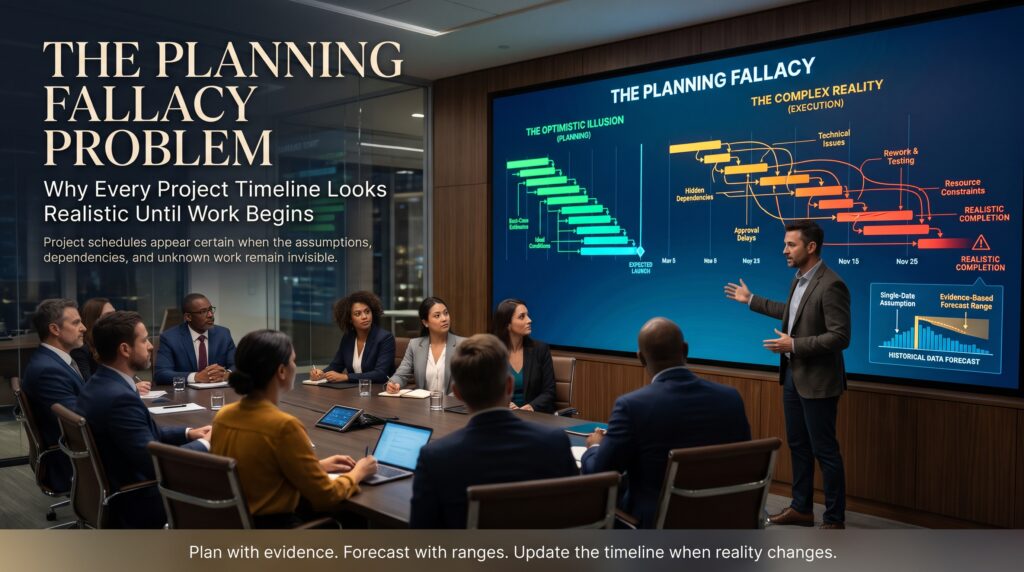
The planning fallacy is the reason your project timeline looked perfectly sensible in the kickoff meeting and slightly absurd by week three. Everyone nodded at the Gantt chart. The milestones were reasonable. The team was confident. Then the work started, and the dates began to slide like they had somewhere better to be.
If that sounds painfully familiar, take comfort: you haven’t hired the wrong people or picked the wrong tools. You’ve run into one of the most well-documented thinking traps in the world of project management. In this guide we’ll explain what the planning fallacy is, why it makes every plan look realistic until reality shows up, and the practical techniques that help project managers in Sydney, Melbourne and across Australia build timelines they can actually hit.
What Is the Planning Fallacy?
The planning fallacy is our stubborn tendency to underestimate how long a task will take, how much it will cost and how many things will go wrong, even when we know that similar tasks have run over before. Psychologists Daniel Kahneman and Amos Tversky named it in the late 1970s, and it has been replicated in everything from student essays to national infrastructure.
The key word is fallacy. It isn’t ignorance. The data from past projects is usually sitting right there in the room, unused. As this PMI research paper on the planning fallacy explains, projects routinely arrive late, over budget or with reduced scope, and one of the main culprits is judging a project as a one-off instead of as one of a family of similar projects.
You’ll often hear it mentioned alongside optimism bias, Hofstadter’s Law (“it always takes longer than you expect, even when you take into account Hofstadter’s Law”) and Parkinson’s Law (work expands to fill the time available). They’re cousins, not twins, but they all point to the same uncomfortable truth: gut-feel estimates are rarely neutral.
Why Every Project Timeline Looks Realistic Until Work Begins
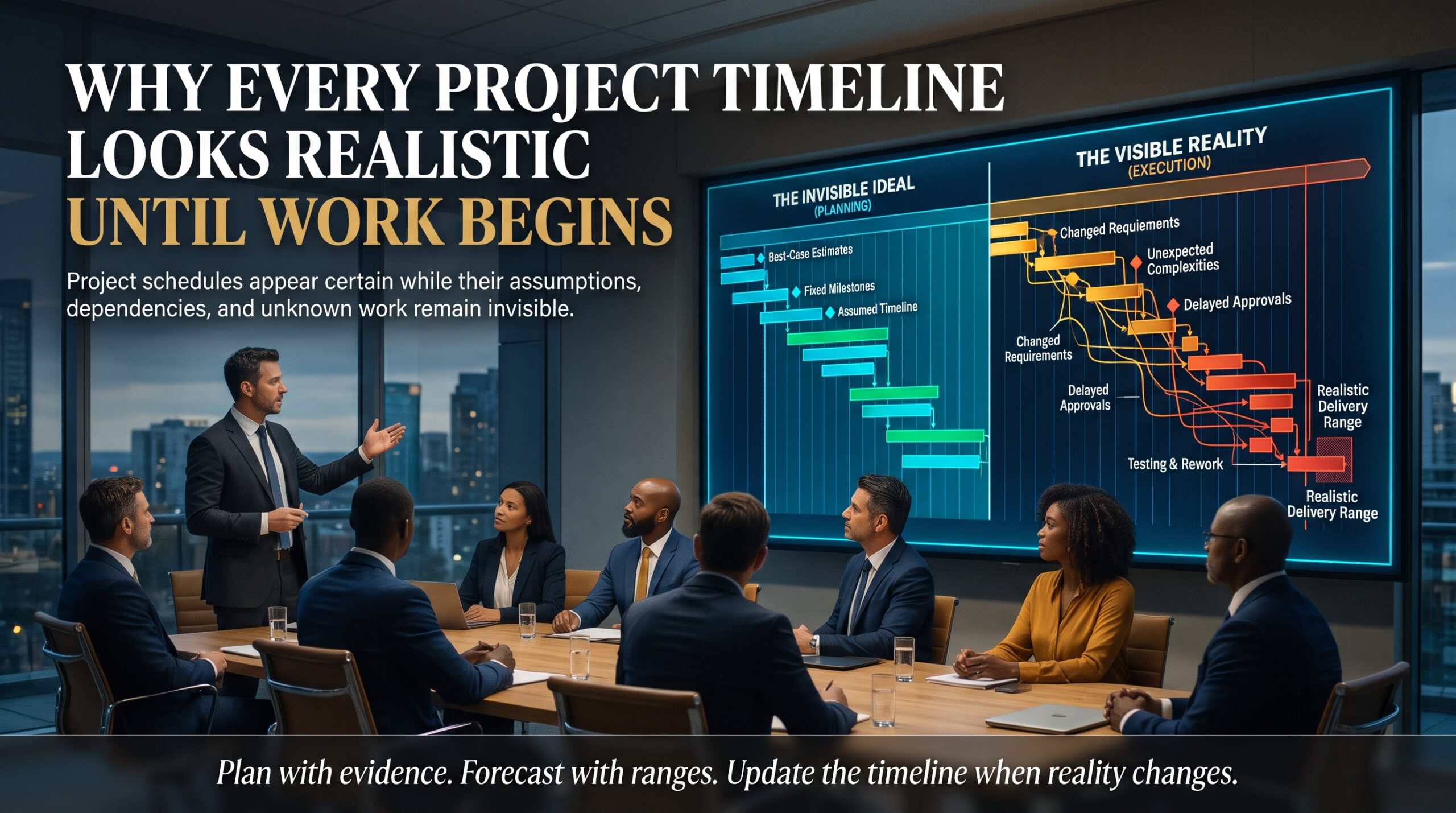
A timeline can feel completely believable and still be wrong. Here are the six forces that make it so hard to spot while you’re still planning.
1. We Plan With the Inside View
When we plan, we naturally think about this project: its tasks, its people, its specific steps. That’s the “inside view”. The “outside view” asks a different question: how long did projects like this one actually take? The inside view feels richer and more convincing, so it wins, even though the outside view is usually more accurate.
2. We Plan for the Best-Case Scenario
Ask someone for an estimate and you’ll often get the time it takes if nothing goes wrong. No sick days. No waiting on approvals. No surprise from legacy systems. Real projects, of course, are full of surprises.
3. We Forget the Unglamorous Work
Plans capture the visible tasks like design, build and launch. They tend to miss the quiet stuff: reviews, rework, meetings, onboarding, testing, handovers and change requests. Added together, that “invisible” work can take up a huge slice of the schedule.
4. Optimism Gets Rewarded in the Room
Nobody wins the pitch by promising the longest timeline. When budgets are competitive and sponsors want good news, optimistic dates get approved and cautious ones get challenged. Some researchers argue this pressure, rather than pure psychology, explains a lot of overruns on large public projects, as discussed in this overview of Flyvbjerg’s work on major projects.
5. Our Estimates Ignore Dependencies
Each task on its own looks manageable. But projects live on handoffs: your task can’t start until someone else’s finishes, and that someone has three other priorities. A schedule built from individually reasonable estimates can still be unreasonable as a whole.
6. A Plan Feels Like a Promise
Once a timeline is on a slide and a date is in an email, everyone starts defending it. The plan stops being a forecast and starts being a commitment, which makes honest updates feel like admitting failure.
Real-World Examples of the Planning Fallacy
Kahneman himself fell for it. While helping to write a textbook on judgment, his team estimated they’d finish in around two years. When he asked a colleague with curriculum experience how long similar projects had taken, the answer was far longer, and a good share never finished at all. The team carried on regardless, and the book took about eight years, a story retold in this deep-dive on the planning fallacy.
Sydney’s Opera House is the classic Australian example. It was expected to be finished in the early 1960s for a small fraction of the final bill, and it ultimately opened in 1973 at a cost many times the original estimate. It’s now an icon, but as a schedule it’s a lesson. Closer to home, anyone who has renovated a bathroom, launched a website or migrated a database has felt the same pattern on a smaller scale.
The Real Cost of the Planning Fallacy in Project Management
Missed dates are only the visible symptom. When it goes unchecked, it quietly causes a chain of other problems:
- Budget blowouts. Time and money are tightly linked, so a late project is almost always an expensive one.
- Scope cuts and quality shortcuts. When time runs out, testing and documentation are the first things squeezed.
- Team burnout. Overtime to rescue an unrealistic plan is a fast route to resignations.
- Eroded stakeholder trust. Repeated slippage makes sponsors sceptical of every future estimate.
- Bad portfolio decisions. If every project is under-estimated, the organisation approves more work than it can ever deliver.
Warning Signs of the Planning Fallacy in Your Project Plan
You can often spot it before the first sprint or milestone. Watch for these red flags:
- Estimates given as single numbers with no range
- No contingency, or contingency that’s quietly consumed by the first small delay
- A timeline built backwards from a fixed launch date rather than forwards from the work
- Plans that assume everyone is available full-time with zero leave or competing priorities
- No comparison with how similar past projects actually performed
- Tasks with durations like “two weeks” that nobody has broken down further
How to Beat the Planning Fallacy: 8 Practical Steps
- Take the outside view. Use reference class forecasting: find a set of similar past projects, look at how long they really took, and use that range as your starting point. Then adjust for what’s genuinely different about your project.
- Break the work down. A solid work breakdown structure exposes the small, forgotten tasks that make big estimates wrong.
- Use three-point estimates. Ask for an optimistic, a most likely and a pessimistic figure for each task. The spread tells you how uncertain you really are.
- Make contingency visible and deliberate. Hold buffer at the project level instead of padding every task, and have a clear rule for who is allowed to spend it.
- Ask the people doing the work. Estimates from people who’ll actually do the tasks are usually better than top-down guesses. Run a quick pre-mortem too: imagine the project has failed, then ask what went wrong.
- Track estimates against actuals. Every finished task is a data point. Capturing it builds your own reference class, which is your best defence next time.
- Fix the time and flex the scope. Instead of promising every feature by a fixed date, agree up front what is essential and what can be dropped if time runs short.
- Review honestly at checkpoints. Use stage gates or regular reviews to re-forecast based on evidence, and treat updated dates as good project hygiene rather than bad news.
How Agile Project Management Helps Tame the Planning Fallacy
Agile approaches don’t cure it, but they shrink its blast radius. Short timeboxes give you frequent real evidence about how fast the team actually works. Prioritising requirements (for example, with MoSCoW: Must, Should, Could, Won’t) lets you protect the essentials while the “nice-to-haves” flex. And because work is delivered in increments, you find out about a bad estimate in weeks instead of months.
That is exactly the thinking behind AgilePM, which fixes time, cost and quality up front and flexes the features. If you’re new to it, the AgilePM Foundation course introduces the framework, roles and techniques. When you’re ready to apply it on live projects, the AgilePM Practitioner course builds on that foundation with practical application.
Planning Fallacy Across Australia: Melbourne, Sydney, Brisbane and Beyond
Wherever projects are delivered, this bias tags along. Government and defence teams in Canberra balance long approval chains with fixed budget cycles. Infrastructure, finance and technology teams in Sydney and Melbourne manage large, interdependent programs with many vendors. Brisbane’s growing pipeline of major public works adds pressure to deliver on public timelines. Resources and engineering projects in Perth and Adelaide often depend on remote sites, specialist suppliers and long lead times, all of which stretch estimates.
Our courses are available in Adelaide, Brisbane, Canberra, Melbourne, Perth and Sydney, and you can also study online from anywhere. Browse every project management training location to find the format that fits you.
Project Management Courses That Help You Beat the Planning Fallacy
Knowing about the planning fallacy is a start. Practising the techniques that counter it is what changes your results. These are good places to begin:
- AgilePM Foundation: a comprehensive introduction to Agile project management concepts, ideal for project coordinators, team leaders and anyone new to Agile delivery. Most introductory courses have no formal prerequisites.
- AgilePM Practitioner: for professionals who want to apply Agile project management in real-world environments, manage changing requirements and keep control and governance throughout the project lifecycle.
- All project management courses: compare pathways, formats and locations in one place.
Have questions? Check our FAQs, read more on the project management blog, learn about us, or contact our team and we’ll help you choose.
Planning Fallacy FAQs
What is the planning fallacy in simple terms?
It is the habit of underestimating how long tasks and projects will take, and how much they will cost, even when we know similar work has run over before.
Who discovered this bias?
Daniel Kahneman and Amos Tversky introduced the concept in 1979. Kahneman later won the Nobel Prize in Economic Sciences for his work with Tversky on decision-making under uncertainty.
How do you avoid the planning fallacy in project management?
Use the outside view by comparing your project with similar completed ones, break work into small tasks, use three-point estimates, hold visible contingency and re-forecast regularly using actual progress data.
Is the planning fallacy the same as optimism bias?
They’re closely related. Optimism bias is the general tendency to expect better outcomes than are realistic. It applies that bias specifically to time, cost and risk in plans.
Can project management training reduce over-optimistic planning?
Yes. Good training teaches structured estimating, risk management, prioritisation and iterative delivery, which are all practical counterweights to over-optimistic planning.
Final Thoughts: Plan for the Project You Will Actually Run
This bias isn’t a sign of weak project managers. It’s a feature of human thinking, which means the answer is process, not willpower. Look outward, break things down, show your uncertainty and let evidence update your plan. Do that consistently and your timelines will keep looking realistic after the work begins, too.
Ready to build those skills? Get in touch or call 1300 649 299 to find the right course for you or your team.