


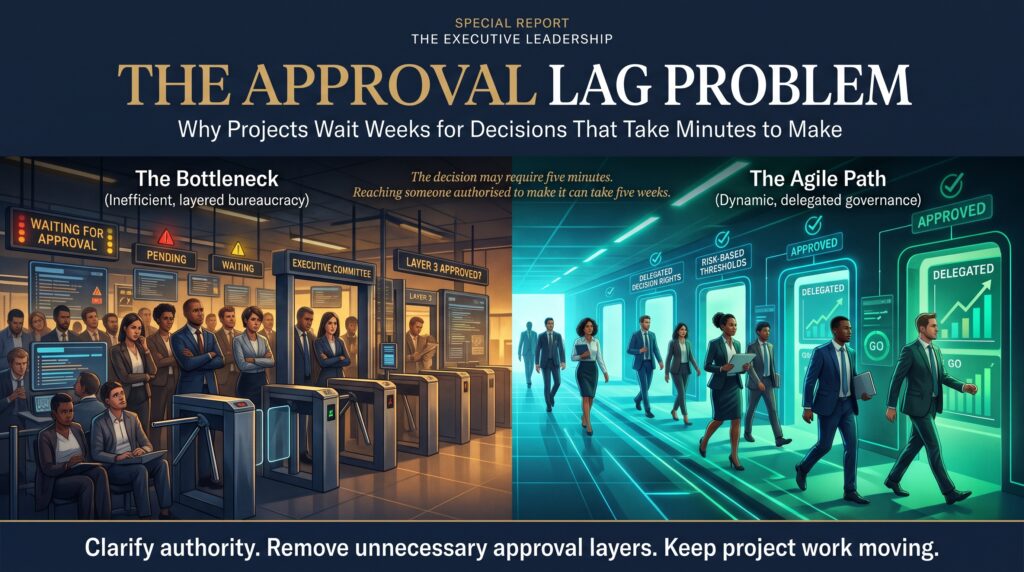
Project approval delays are rarely about the decision itself. A change request that takes ten minutes to assess can sit in an inbox for three weeks while the team keeps working, the budget keeps burning and the sponsor wonders why delivery is slipping. If that sounds familiar, you have met the approval lag problem.
In this guide we unpack why project approval delays happen, what they really cost, and how project managers in Sydney, Melbourne, Brisbane, Perth, Adelaide and Canberra can shorten the wait without losing governance. You will also find a ready-to-use approval service level you can adapt this week.
What Is the Approval Lag Problem?
Approval lag is the gap between the moment a decision is ready to be made and the moment someone actually makes it. The analysis is done. The options are clear. The recommendation is written. Yet the item waits for a signature, a steering committee slot or a reply that never arrives.
The decision might take five minutes. The wait is the problem. Most project approval delays sit in the queue, not in the thinking, which is why polishing the analysis rarely helps.
Think of it as idle time in a pipeline. Work moves quickly while someone is holding it and stops completely when it lands in someone else’s queue. Add four or five handoffs and a simple approval turns into a month.
Why Project Approval Delays Happen
The same causes appear again and again, across industries and project sizes. Here are the five that do the most damage.
1. Nobody is sure who can say yes
When decision rights are vague, everyone assumes someone else owns the call. Requests get forwarded “for visibility”, and visibility quietly turns into a veto. A RACI chart helps with tasks, but decisions need sharper roles. Bain & Company built its RAPID decision-making tool for exactly this reason: unclear roles can derail even well-framed decisions.
2. Too many approvers on the path
Every extra approver adds a queue. Five approvers who each take two days means ten days of elapsed time, even if each one spends only a few minutes on the request. Sequential sign-off is the biggest single multiplier of project approval delays.
3. Decisions wait for the next meeting
Fortnightly steering committees and monthly governance boards turn urgent items into scheduled ones. A decision that was ready on Tuesday waits until the next meeting, then gets deferred because one paper was missing.
4. Incomplete requests
Approvers send items back with questions the requester could have answered upfront. Each loop restarts the clock, and a two-day approval becomes a two-week conversation.
5. Fear of accountability
Approving something means owning the outcome. Without a clear risk threshold, doing nothing can feel safer than saying yes, so senior stakeholders hold off until they feel fully covered.
The Real Cost of Project Approval Delays
The damage goes well beyond the days on the calendar. Here is what teams typically pay for waiting.
- Idle or rework time: people move to other work, lose context and need time to restart.
- Budget burn: salaries, contractors and licences keep costing money while the decision sits.
- Missed windows: vendor pricing, procurement slots and regulatory dates do not wait for your committee.
- Lost trust: sponsors see slippage, and teams stop raising issues early because they know the answer will be slow.
- Bigger decisions later: deferred changes pile up and arrive as one large, harder-to-approve request.
Over time, project approval delays also change behaviour. Teams stop asking and start working around governance, which creates exactly the risk the approvals were meant to prevent.
How to Reduce Project Approval Delays: 7 Practical Fixes
You do not need to remove governance. You need to make it faster and more predictable. These seven fixes work on projects of almost any size.

- Name one decider per decision. Many people can give input, but only one person should have the final say. Single-point accountability removes the “who is signing this?” stall.
- Set decision thresholds. Agree delegated authority upfront. For example, the project manager approves low-cost changes, the sponsor approves mid-range ones, and the steering committee handles the rest.
- Review in parallel, not in sequence. Send the request to all reviewers at once with a deadline. Parallel review can turn ten days of queueing into two.
- Use silence-is-consent windows for low-risk items. If nobody objects within 48 hours, the item proceeds. Reserve this for decisions that are easy to reverse.
- Make every request decision-ready. Use a one-page template covering the decision needed, the options, your recommendation, the impact on cost, time and risk, and the date a decision is required.
- Meet often and briefly. A fifteen-minute decision stand-up twice a week beats a ninety-minute board every month.
- Measure approval cycle time. Track how long requests wait. What gets measured gets discussed, and project approval delays shrink once they are visible in the status report.
A Simple Approval Service Level You Can Copy
A service level agreement for decisions sounds formal, but it can fit on one page. Adjust the thresholds and times to suit your organisation.
| Decision type | Who decides | Response time | If no response |
| Minor change (low cost, no schedule impact) | Project manager | Same day | Proceeds |
| Standard change | Project sponsor | 2 business days | Sponsor’s delegate decides |
| Budget or scope change | Steering committee chair | 5 business days | Chair approves out of session |
| Major risk or contract variation | Steering committee | Next meeting, or out of session within 5 days | Chair decides |
Publish this table in your project governance plan. When everyone can see the expected response time, project approval delays stop being invisible and start being fixable.
How Agile Governance Shortens Approval Cycles
Agile delivery has a built-in answer to approval lag. Instead of pushing every decision up the hierarchy, it moves decisions to the people closest to the work, within boundaries everyone has agreed. In AgilePM, defined roles, timeboxes and empowered teams keep decisions moving while governance stays intact. The framework is maintained by the Agile Business Consortium.
If you are new to this approach, the AgilePM Foundation course is a strong starting point. When you are ready to apply it on live work, the AgilePM Practitioner course shows you how to manage changing requirements and keep control without stalling for sign-off.
Project Approval Delays Across Australian Cities
The cause is the same everywhere, but the pressure point changes with the industries that shape each city’s project landscape.
- Sydney and Melbourne: large technology, finance and infrastructure programs often carry layered governance, so approval chains grow long. See our training options in Sydney and Melbourne.
- Canberra: government projects rely on formal delegations and committees, which makes clear decision rights essential. Explore project management courses in Canberra.
- Brisbane: construction and infrastructure work often depends on approvals that gate procurement and site activity. Learn more about Brisbane
- Perth: resources and engineering projects feel the cost of waiting quickly when crews and equipment are on standby. Find out about Perth
- Adelaide: defence, health and public sector projects often need rigorous sign-off, so predictable approval paths matter. Check Adelaide course details.
Our courses are available in Adelaide, Brisbane, Canberra, Melbourne, Perth, Sydney and online, so you can build these skills wherever you work.
Build the Skills to Fix Approval Lag
Process changes help, but the people leading projects also need to design governance, influence senior stakeholders and make decisions visible. That is what structured training develops: stakeholder communication, risk management, scheduling and leadership.
Browse all of our project management courses online, read more practical tips on the project management blog, check the FAQs, or contact our team on 1300 649 299. For wider benchmarks on how organisations perform, the Project Management Institute’s Pulse of the Profession research is a useful reference.
Project Approval Delays: Frequently Asked Questions
What causes project approval delays?
The most common causes are unclear decision rights, too many sequential approvers, meeting-driven governance, incomplete requests and fear of accountability. Most of the delay is waiting time, not decision time.
How long should a project approval take?
It depends on risk. As a guide, minor changes should be approved the same day, standard changes within two business days, and major budget or scope changes within five business days.
How do you reduce project approval delays without losing control?
Define one decider per decision, set delegated authority thresholds, review in parallel and publish response times. Control comes from clarity, not from extra layers of sign-off.
Which course helps with approvals and project governance?
The AgilePM Foundation and AgilePM Practitioner courses both cover roles, timeboxing and decision-making in project delivery. You can compare them on our courses page.
Final Thoughts
Project approval delays are a design problem, not a character flaw. People are not slow on purpose; the system gives them no clear owner, no deadline and no safe threshold for saying yes. Fix those three things and decisions that take minutes will finally take minutes. Ready to lead projects that keep moving? Explore our courses and start today.