


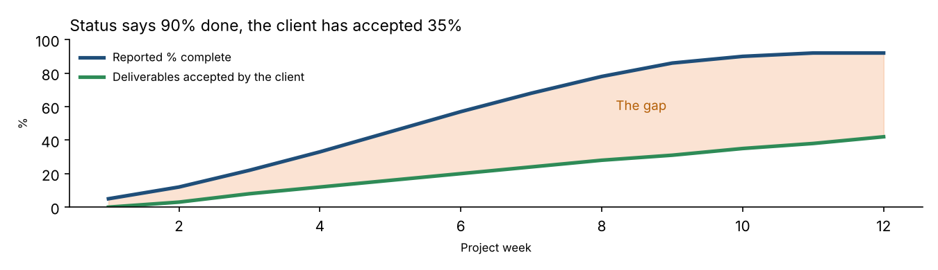
The milestone acceptance gap is the distance between what a project report says is finished and what the client has actually accepted. A status update shows 90% complete and every light is green, yet the sponsor cannot sign off a single deliverable. If you have ever been told a milestone is “done” only to find it cannot be used, tested or approved, you have met the milestone acceptance gap.
This guide explains why the gap opens, how to spot it early, and how to close it with simple habits. It is written for project managers, coordinators, team leaders and sponsors across Australia, from Sydney and Melbourne to Brisbane, Perth, Adelaide and Canberra.
What Is the Milestone Acceptance Gap?
A milestone marks a significant point in a project: a design approved, a system built, a site handed over. In theory, reaching it proves the work behind it is complete. In practice many teams report a milestone as reached when the effort is finished, not when the deliverable has been accepted.
That small difference matters. Effort is easy to count (hours worked, tasks closed). Acceptance needs someone outside the team to look at the result and say yes. The milestone acceptance gap is the space between those two points, and it is where schedules, budgets and relationships quietly fall apart.
You will find the formal side of this in standard project management practice, where scope validation means getting formal acceptance of completed deliverables. The idea is not new. The problem is that status reports often skip it.
Why the Milestone Acceptance Gap Happens
Almost nobody sets out to mislead. The gap grows from ordinary habits and pressures:
- Milestones describe activity, not outcomes. “Build module” sounds like progress, but it does not say what a finished module looks like.
- Progress is measured by effort. Reporting 80% complete because 80% of the hours are spent tells you nothing about whether the work meets the need.
- Acceptance criteria are vague or missing. If nobody agreed what “done” means, everyone assumes their own version.
- No named person to accept. The sponsor, the client and the end users each think someone else will review it.
- Pressure to stay green. Teams worry that an honest amber or red will trigger tough questions, so they round up.
- Payments tied to milestones. When invoices depend on reaching a milestone, there is a strong pull to declare it reached.
- Testing and review are pushed to the end. Quality checks and user acceptance testing arrive late, when problems are costly to fix.
- Dependencies are hidden. The deliverable is “finished”, but it still needs data, approvals, training or a third party before it works.
Put those together and the milestone acceptance gap becomes the default, not the exception.
Warning Signs of a Milestone Acceptance Gap
Look for these signals in your own projects:
- The report is mostly green, but stakeholders keep asking “when will we actually see it?”
- Milestones are marked complete, then reopened or quietly reworked.
- Progress jumps to 90% quickly, then stalls for weeks at “almost done”.
- The client finds issues in review that the team never mentioned.
- Nobody can say who signed off a deliverable, or when.
- The last 10% of the project takes as long as the first 90%.
- Team members describe the same milestone differently.
Example: A Milestone Acceptance Gap in a Software Rollout
Imagine a health provider in Brisbane rolling out a new booking system. At week eight, the project report says the “build” milestone is 100% complete. The vendor has finished the screens and the team has closed every development task.
At the client demo, staff find that appointment reminders do not send, two clinics are missing from the location list and the patient search is slow. None of this was written down as an acceptance criterion, so nobody flagged it. The milestone is reopened, the go-live moves back six weeks and the sponsor stops trusting the status report. (This is an illustrative scenario, not a specific client.)
The Cost of the Milestone Acceptance Gap
The gap is not a reporting quirk. It has real consequences:
- Watermelon projects. Green on the outside, red on the inside. Problems stay hidden until it is too late to fix them cheaply.
- Rework and delay. Fixing a defect found at acceptance costs far more than catching it during the work.
- Budget overruns. Money is spent against “complete” milestones, then spent again to finish them properly.
- Disputes with suppliers and clients. Arguments about whether a milestone was met can damage contracts and relationships.
- Lost trust. Once a sponsor catches one optimistic report, every future report is doubted.
- Poor decisions. Leaders approve funding and set launch dates based on progress that does not exist.
How to Close the Milestone Acceptance Gap: 7 Steps
1. Define milestones as accepted outcomes
Rewrite each milestone as a result someone can verify. Instead of “complete reporting module”, write “finance team has reviewed and approved the monthly report with live data”.
2. Agree acceptance criteria before work starts
Write down what “done” means in plain language: what it must do, how it will be tested and who will test it. This is the single biggest fix for the milestone acceptance gap.
3. Name the person who accepts
Every deliverable needs one named acceptor, plus a deadline for review. Silence should never count as approval.
4. Report accepted work, not just completed work
Show two numbers in every status report: work finished by the team and work accepted by the client. Watch how the difference changes week to week.
5. Use evidence, not opinion
Back each status with proof: a demo, a test result, a signed form, a screenshot. Methods like earned value management can help, but only if “earned” means accepted.
6. Deliver in small, reviewable pieces
Break large milestones into smaller increments that can be shown and accepted often. Agile approaches such as timeboxing and regular demos make the milestone acceptance gap visible within weeks instead of months.
7. Review the gap at every checkpoint
Add a standing item to project meetings: “What did we report as done that has not been accepted?” Treat the answer as useful information, not as blame.
Reported Status vs Acceptance-Based Status
| Area | Typical reporting | Acceptance-based reporting |
| Milestone definition | Task or phase finished | Outcome reviewed and signed off |
| Progress measure | % of hours or tasks complete | % of deliverables accepted |
| Quality checks | Done at the end | Built into each increment |
| Status colour | Based on schedule feel | Based on evidence and open acceptance items |
| Payments or invoices | Tied to “reached” milestones | Tied to accepted milestones |
| Sponsor view | Surprises at handover | Early, honest visibility |
Milestone Acceptance Checklist for Project Managers
- Is every milestone written as an outcome someone can verify?
- Are acceptance criteria written, agreed and stored where everyone can find them?
- Is there a named acceptor and a review deadline for each deliverable?
- Does the status report show accepted work separately from completed work?
- Have testing, demos and user reviews been scheduled before the milestone date?
- Are dependencies such as data, approvals and training listed and tracked?
- Is there a simple record of who accepted what, and when?
What Do Project Management Frameworks Say About Acceptance?
The major frameworks all point in the same direction. The Project Management Institute describes scope validation as the formal acceptance of finished deliverables. PRINCE2 uses product descriptions with clear quality criteria so everyone knows what “finished” means. Agile approaches, including AgilePM from APMG International, use timeboxes, prioritisation and frequent reviews so working results are shown early and often.
For Australian practitioners, the Australian Institute of Project Management is a useful place to explore standards, events and professional development.
Build the Skills: Project Management Courses in Australia
Closing the milestone acceptance gap is a skill, not a template. Good training teaches you how to write acceptance criteria, run honest status reporting and work with sponsors under pressure. Explore our full range of project management courses, including the AgilePM Foundation course for a strong introduction to Agile delivery and the AgilePM Practitioner course for applying it on real projects.
Study online or choose a location near you:
- Project management courses in Sydney
- Project management courses in Melbourne
- Project management courses in Brisbane
- Project management courses in Perth
- Project management courses in Adelaide
- Project management courses in Canberra
Not sure where to start? Read our FAQs, see all training locations, learn about us or contact the team on 1300 649 299 and we will help you choose.
Milestone Acceptance Gap FAQs
What is the milestone acceptance gap?
It is the difference between what a project reports as complete and what the client or sponsor has formally accepted. A large gap means status reports are more optimistic than reality.
Why do projects report progress before deliverables are ready?
Common reasons include vague acceptance criteria, effort-based progress tracking, pressure to show green status and payments linked to milestones. Late testing also hides problems until the end.
How do I define acceptance criteria for a milestone?
Describe in plain language what the deliverable must do, how it will be checked, who will check it and what evidence counts. Agree this with the sponsor before the work begins.
Is percent complete a reliable way to track progress?
Only when it is based on accepted deliverables. Percent complete based on hours or tasks can look healthy while the real result is far behind.
Which course helps with delivering accepted outcomes?
Agile courses such as AgilePM Foundation and AgilePM Practitioner focus on regular delivery, collaboration and clear acceptance. Browse all courses to compare options.
Final Thoughts on the Milestone Acceptance Gap
The milestone acceptance gap does not come from bad people. It comes from unclear definitions and the pressure to look on track. Define milestones as accepted outcomes, agree acceptance criteria early, name your acceptors and report accepted work next to completed work. Do that and your status reports will stop surprising people, and your projects will finish when you say they will.
Ready to sharpen these skills? Explore our project management courses online or get in touch today. For more practical advice, visit the Project Management Courses Online blog.