
A project health check is a structured review that tells you whether a project is genuinely on track or quietly heading for trouble long before the status report turns red. Most failing projects don’t fail overnight; they drift for weeks while status reports stay green because nobody wants to be the one raising the flag. This guide walks through the warning signs, the health check framework Australian project managers use, and how PRINCE2 and PMP tools help you catch problems while there’s still time to fix them.
Whether you’re managing projects in Sydney, Melbourne, Brisbane, Perth, Adelaide or Canberra, the same core health check principles apply the trick is running them often enough, and honestly enough, to matter.
What Is a Project Health Check?
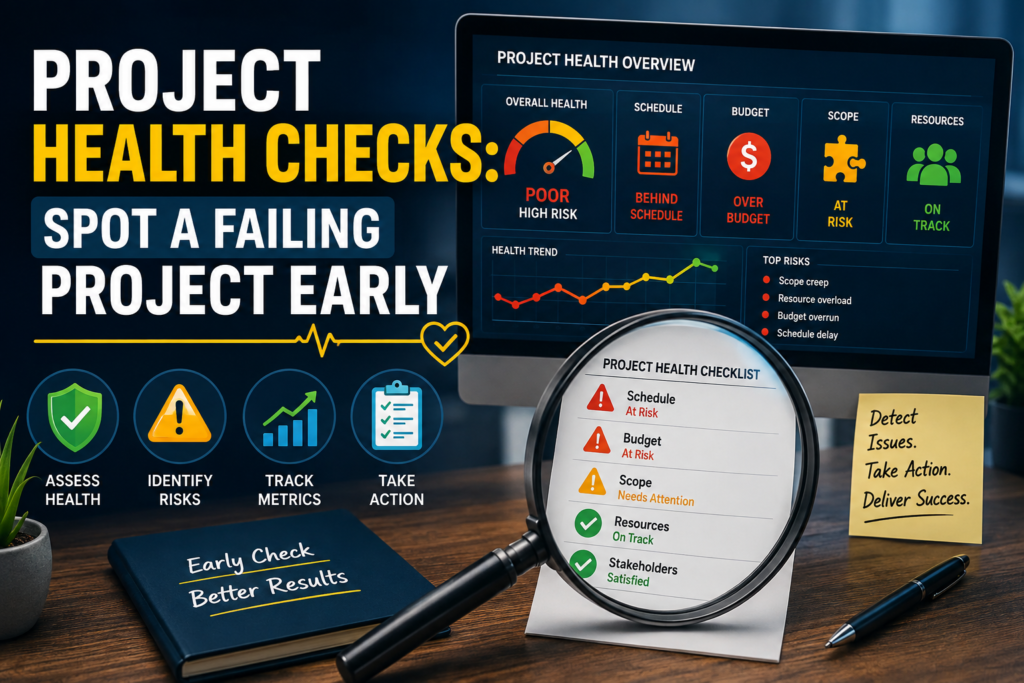
A project health check is a periodic, structured review of a project’s scope, schedule, budget, risk, quality and stakeholder sentiment done independently of the usual status report. Unlike a weekly status update, which tends to reflect what the project manager wants to report, a proper health check actively looks for the gap between what’s being reported and what’s actually happening on the ground.
In PRINCE2, this maps closely to the end-stage assessment and the role of the Project Board in deciding whether a project should continue, change direction, or stop. In PMP and PMI-based environments, it aligns with structured status reporting supported by earned value management (EVM) data rather than subjective progress percentages.
Why Project Health Checks Matter
- Most troubled projects show early warning signs weeks or months before they’re formally declared “at risk.”
- Status reports are often optimistic by default — a health check forces an honest, independent look.
- Catching problems early gives you options: re-scope, re-resource, or reset expectations. Catching them late usually leaves only one option: damage control.
- Sponsors and steering committees increasingly expect data-backed health indicators, not just a traffic-light colour with no evidence behind it.
Key Warning Signs a Project Is Failing
Run a project health check the moment you notice more than one or two of these signs together:
- Milestones are consistently reported as “on track” right up until they’re missed.
- Scope keeps expanding without a corresponding change to budget or schedule (classic scope creep).
- Team members privately raise concerns that never make it into the formal status report.
- Risk register hasn’t been updated in several weeks, or every risk is rated “low.”
- Key stakeholders stop attending steering meetings, or send delegates instead.
- The same issues appear in status reports week after week with no resolution date.
- Budget burn rate is outpacing percentage of work completed.
The Project Health Check Framework
A useful health check looks across six dimensions, each scored independently rather than rolled into a single vague RAG status.
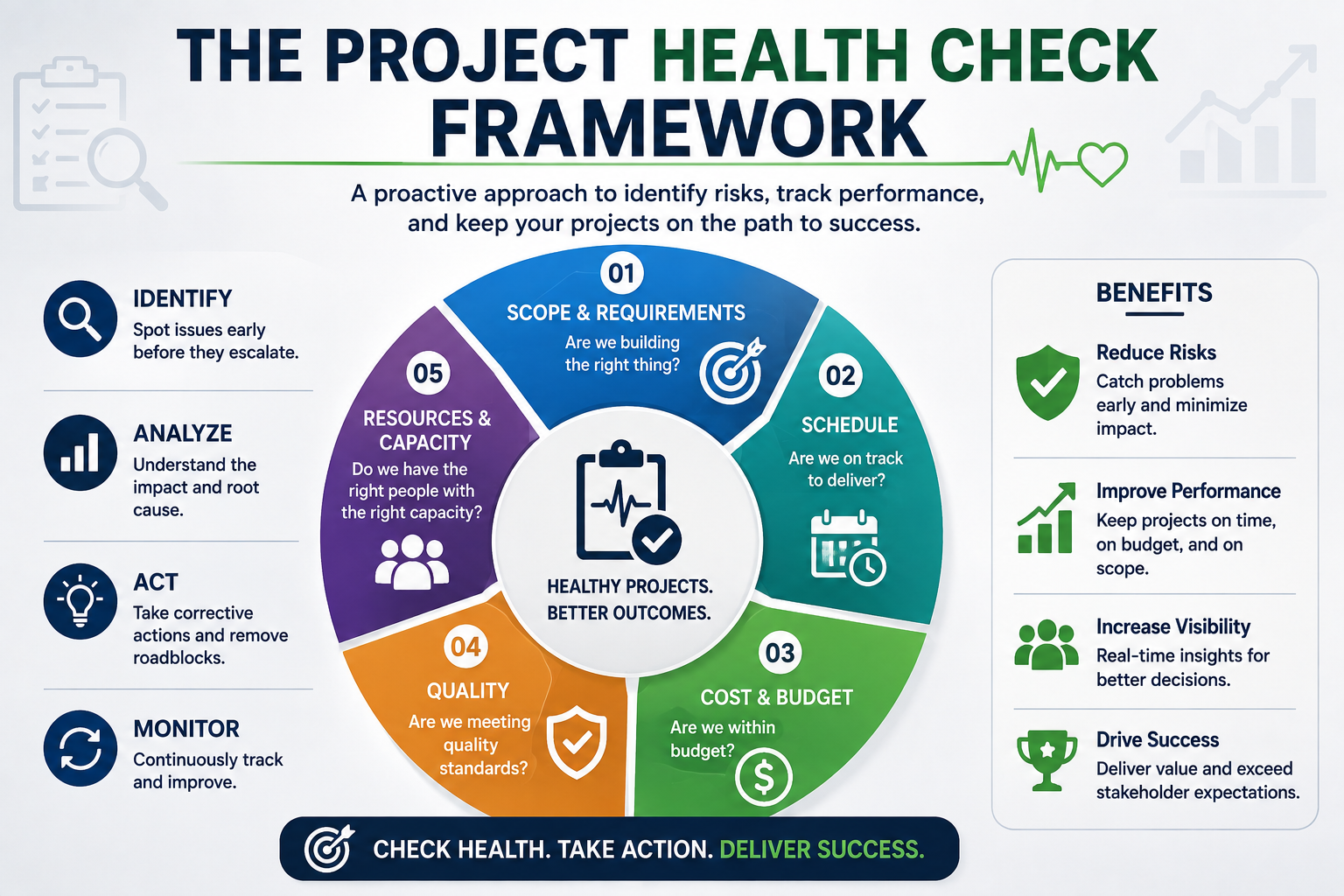
| Dimension | What to Check | Red Flag Example |
| Scope | Is delivered scope matching the approved baseline? | Unapproved feature or requirement additions |
| Schedule | Are milestones tracking to the baseline plan? | Critical path tasks slipping repeatedly |
| Budget | Is spend proportional to work completed? | Cost variance (CV) trending negative |
| Risk | Is the risk register live and being actioned? | Stale register, no owners assigned |
| Stakeholders | Is engagement and sponsorship still active? | Sponsor disengaged, conflicting priorities |
| Team | Is morale and capacity sustainable? | High overtime, turnover, or silent disengagement |
How PRINCE2 and PMP Support Project Health Checks
PRINCE2’s end-stage assessments and exception reports exist precisely for this purpose giving the Project Board a formal checkpoint to continue, adjust, or stop a project before problems compound. If you want the full method behind these controls, see our comparison of PMP vs PRINCE2 in Australia for how each framework structures these checkpoints differently.
PMP-aligned projects typically lean on earned value management: Schedule Performance Index (SPI) and Cost Performance Index (CPI) give an early, numeric warning long before a milestone is formally missed. An SPI or CPI trending below 0.9 for two consecutive reporting periods is a strong signal to run a full health check.
Real-World Example: Catching a Failing Project Early
Consider a mid-sized system implementation where weekly status stayed “green” for two months. A quarterly health check found the risk register hadn’t been updated in six weeks, scope had grown by 15% without a formal change request, and the sponsor had missed the last three steering meetings. None of this showed up in the status report alone it only surfaced because the health check looked at scope, risk and stakeholder engagement independently. The project was re-scoped and re-baselined, which as covered in our guide to Agile vs Traditional Project Management sometimes also means reconsidering whether a more iterative delivery approach would reduce this kind of drift in future.
How to Run a Project Health Check
- Schedule health checks on a fixed cadence (monthly or quarterly), not just when something already feels wrong.
- Use someone outside the immediate delivery team a PMO lead or peer PM to reduce reporting bias.
- Score each of the six dimensions independently rather than rolling everything into one RAG status.
- Compare current data against the original baseline, not just last week’s report.
- Document findings and agreed actions, then track them to closure at the next check.
Project Health Checks Across Australia
- Sydney and Melbourne — larger programs often run formal quarterly PMO-led health checks alongside monthly status reporting.
- Brisbane and Perth — resources and infrastructure projects frequently combine health checks with formal stage gate reviews.
- Adelaide and Canberra — government projects tend to build health checks into existing governance and assurance frameworks.
Build the Skills to Run Effective Health Checks
Health checks work best when they’re backed by a proper project management framework. PRINCE2 Foundation and Practitioner training covers the stage boundaries, exception reporting and board-level controls that make early intervention possible.
For teams working with earned value and formal status reporting, PMP certification covers SPI, CPI and the broader PMI framework in depth.
If your projects run in sprints, our Agile vs Traditional Project Management guide explains how health checks differ (and often get easier) in an Agile delivery model.
For career and salary context, see our Project Manager Salary Australia guide PMs who can run a rigorous health check are consistently among the most valued in the market.
Explore accredited project management courses at Logitrain, delivered across Sydney, Melbourne, Brisbane, Perth, Adelaide and Canberra, both in person and online.
Frequently Asked Questions
How often should a project health check be run?
Monthly for high-risk or high-value projects, quarterly at minimum for everything else. Projects showing early warning signs should be checked more frequently until they stabilise.
Who should conduct a project health check?
Ideally someone outside the immediate project team a PMO representative, a peer project manager, or an independent reviewer to reduce the reporting bias that comes from the delivery team assessing itself.
What’s the difference between a status report and a health check?
A status report is produced by the project team and tends to reflect intended progress. A health check is an independent, structured review that specifically looks for the gap between reported status and actual project reality.
Can Agile projects still benefit from health checks?
Yes. Even with sprint reviews and retrospectives, an independent health check across scope, budget, risk and stakeholder engagement catches issues that day-to-day ceremonies can miss, especially on longer programs made up of multiple Agile teams.
Conclusion
A project health check is one of the simplest, highest-value habits a project manager or PMO can build. Projects rarely fail suddenly they drift, and drift is exactly what an honest, independent health check is designed to catch. Whether you use PRINCE2’s stage assessments, PMP’s earned value data, or a simple six-dimension framework, the goal is the same: find the problem while there’s still time to change the outcome.