


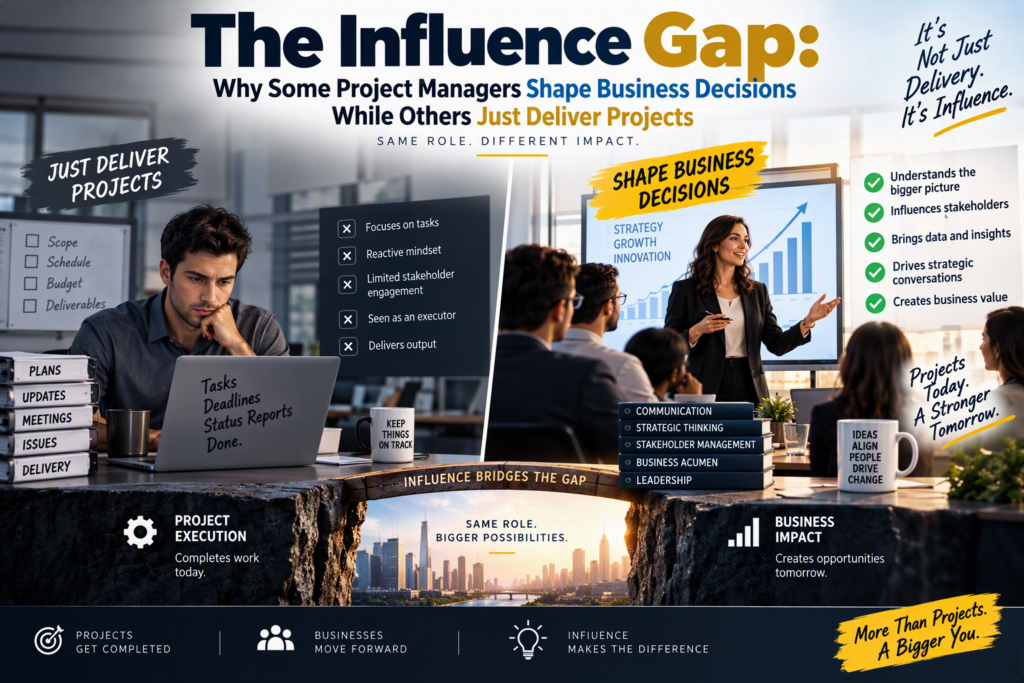
Project managers shape business decisions long before those decisions ever reach a steering committee while other equally competent PMs spend their entire career executing plans someone else made. Sit in enough project boards and you’ll notice the same split: one PM is asked what the business should do next; another is asked only whether the Gantt chart is on track. Both may run flawless projects. Only one is building a career.
What Is the Influence Gap in Project Management?
The influence gap is the difference between project managers who are consulted on strategic direction and those who are only consulted on delivery status. It has almost nothing to do with certification level or years of experience, and almost everything to do with how a PM positions their judgement inside the business.
Understanding why some project managers shape business decisions starts with recognising that delivery competence is now a baseline expectation, not a differentiator. Every certified PM can build a schedule and track a budget. The PMs who get pulled into strategic conversations are the ones who translate project data into business consequence risk, cost, market timing rather than just status.
Delivery PM vs. Influence PM: What’s Actually Different
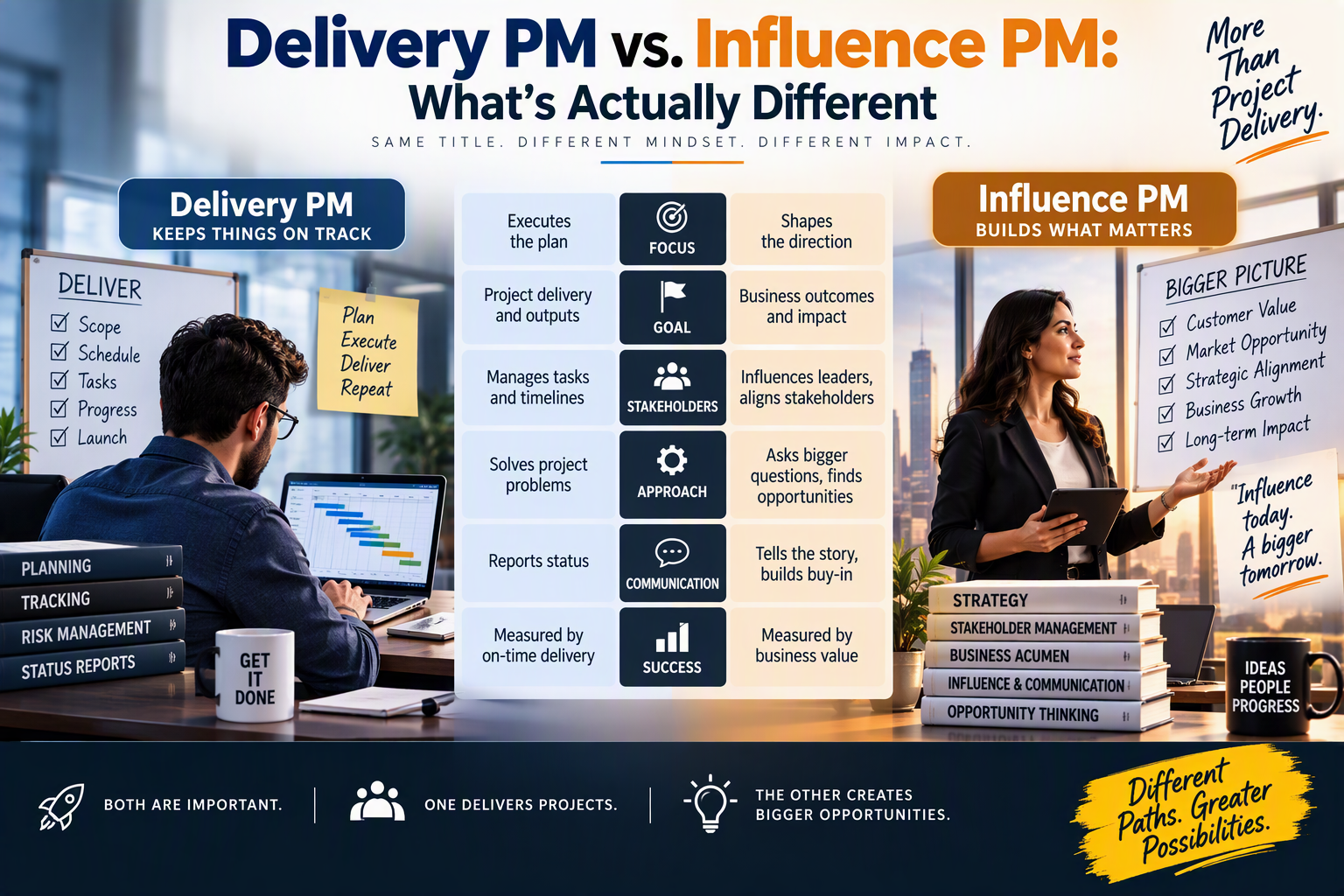
| Behaviour | Delivery-Only PM | Influence PM |
| Reporting | Reports RAG status and milestone dates | Reports business impact of schedule and risk changes |
| Stakeholder role | Updates stakeholders | Advises stakeholders on trade-offs and options |
| Risk framing | Logs risks in a register | Quantifies risk in cost, revenue or reputational terms |
| Meeting presence | Attends to report status | Invited to shape scope and strategic options |
| Career trajectory | Senior Project Manager (delivery track) | Program Manager, PMO Lead, or business leadership track |
This distinction closely mirrors the PMI Talent Triangle, which identifies business acumen and strategic thinking not just technical project management skill as the differentiator between PMs who advance and those who plateau in delivery-only roles.
Why Certification Alone Doesn’t Close the Gap
A PMP Certification or PRINCE2 Practitioner qualification proves you can run a controlled, well-governed project. It does not, by itself, teach you how to reframe a schedule slip as a revenue-timing risk the CFO needs to hear about. That translation skill is learned separately through business acumen, stakeholder exposure, and deliberate practice communicating in commercial terms.
This is the same root cause explored in our related posts on why capable PMs get stuck at the same level while others advance faster despite similar technical backgrounds.
The Real Cost of Staying in the Delivery-Only Lane
| Career Stage | Typical Impact | Root Cause |
| 3–5 years, delivery-only | Plateau at Senior PM; passed over for Program Manager roles | No track record of shaping decisions, only executing them |
| 5–8 years, delivery-only | 10–20% salary gap vs. influence-track peers | Perceived as an executor, not a strategic advisor |
| 8+ years, delivery-only | PMO or Program roles filled by less experienced influence-track PMs | Promotion panels prioritise demonstrated business impact over tenure |
City-by-City: Where the Influence Gap Shows Up Most
How strongly this gap affects career progression varies by market maturity and industry mix across Australia:
| City | Where PMs Plateau | What Closes the Gap Locally |
| Sydney | Large corporate PMOs with rigid delivery-track roles | Demonstrated commercial framing in steering committee papers |
| Melbourne | Process-heavy government and enterprise programs | Structured business-case and benefits-realisation skills |
| Brisbane | Smaller PMOs, fewer defined strategic-PM roles | Direct exposure to executive stakeholders early in career |
| Perth | Resources-sector projects with technical-only scope | Cross-functional exposure beyond pure schedule/cost control |
| Adelaide | Limited senior program roles available locally | Visible ownership of cross-team strategic initiatives |
| Canberra | Structured APS career pathways | Certifications mapped to classification levels plus policy fluency |
5 Ways Influence-Track Project Managers Operate Differently
1. They Speak in Business Outcomes, Not Project Status
Instead of “we’re two weeks behind,” an influence PM says “a two-week slip pushes our market entry past the competitor’s launch window here are three ways to recover it.”
2. They Build Their Case in Writing
A one-page options paper with cost, risk and recommendation gets read by executives; a status report rarely does. Influence PMs default to the format decision-makers actually consume.
- They quantify risk in dollars, not likelihood ratings. “Medium risk” means nothing to a CFO; “$180K exposure if this slips past Q3” gets a decision made.
- They build relationships before they need them. Influence PMs are known to sponsors before a crisis forces an introduction.
- They complete formal business-acumen and strategic training. Structured Agile Scrum Master and PRINCE2 Foundation training, paired with deliberate business-case practice, builds this skill faster than experience alone.
How to Start Closing the Influence Gap
If you recognise yourself as a delivery-only PM, the fastest path forward combines certification with deliberate visibility. Compare frameworks in our PMP vs PRINCE2 Australia guide, understand delivery-style trade-offs in Agile vs Traditional Project Management, and benchmark where you sit against the market in our Project Manager Salary Australia guide. For a deeper look at why capable PMs plateau, see our posts on the project management skills gap and why some project managers get promoted while others stay stuck.
For structured training that builds both delivery credibility and the business acumen influence PMs rely on, Logitrain runs Australian-delivered PRINCE2, PMP and Agile Scrum Master courses designed around exactly this kind of career progression.
Frequently Asked Questions
Why do some project managers shape business decisions while others don’t?
Because they translate project data into business consequence cost, risk, timing rather than reporting status alone, which is what gets them invited into strategic conversations.
Does certification alone close the influence gap?
No certification proves delivery competence, but business acumen and stakeholder communication are what determine whether a PM is seen as strategic or purely operational.
Can a delivery-focused PM become an influence-track PM?
Yes by deliberately reframing reporting in business terms, building relationships with sponsors early, and pursuing structured training in business case development and strategic communication.
Is this gap more about personality or skill?
It’s primarily skill and habit commercial framing, written business cases and stakeholder positioning can all be learned and practised deliberately.
Final Word
The influence gap explains why project managers shape business decisions while equally capable peers spend a career executing someone else’s plan. Certification builds the delivery foundation; business acumen, commercial framing and deliberate stakeholder positioning are what turn that foundation into genuine influence and a faster path to program and leadership roles.