


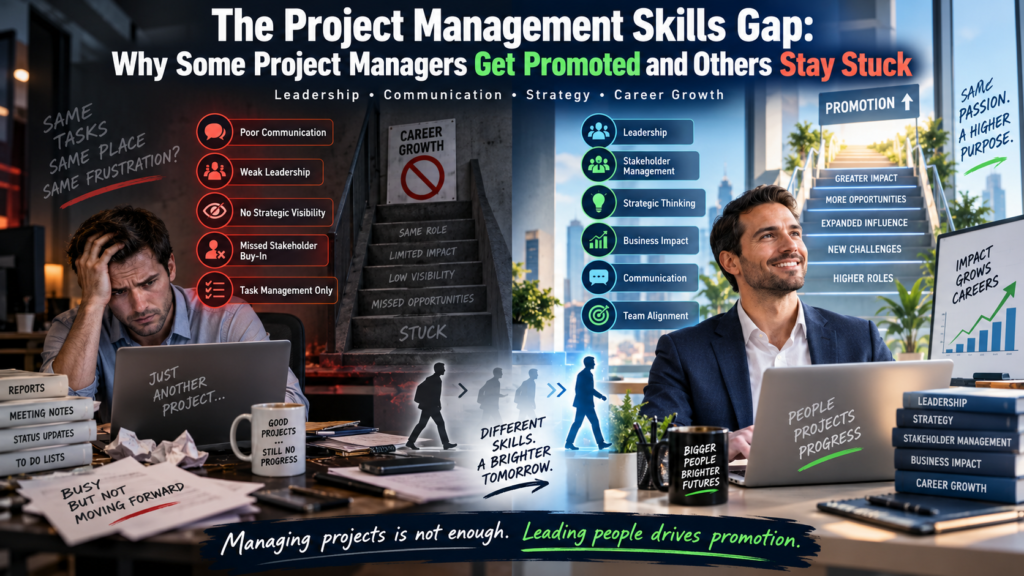
Two project managers can hold the exact same certification, run projects of similar size, and hit similar delivery numbers and still end up on completely different trajectories. One gets pulled into senior and program-level conversations within two years. The other delivers solidly, year after year, and never quite gets the tap on the shoulder. That’s the project management skills gap in action: it’s rarely about who’s better at scheduling or scope control. It’s about a specific set of skills that certifications teach you to recognise but rarely force you to practise.
Closing the Project Management Skills Gap: What Actually Separates the Two Groups
PMP and PRINCE2 both build strong technical foundations scope, schedule, risk, governance. That’s necessary, but it’s also the baseline every certified PM already has. The project management skills gap opens up in the layer above that: the skills that get exercised in messy, political, ambiguous situations rather than in a controlled exam scenario.
1. Stakeholder Influence vs Stakeholder Management
Every certification teaches stakeholder management identify, analyse, communicate. Promoted PMs go one step further: they influence stakeholders toward a decision, not just keep them informed of one that’s already been made. That’s a different skill, and it’s almost never taught directly.
2. Business Case Fluency vs Task Delivery Fluency
A PM who can explain why a project matters in terms of revenue, risk, or strategic positioning gets invited into planning conversations before a charter even exists. A PM who only speaks in tasks, milestones, and RAG status stays in a purely execution-focused role, however well they execute.
3. Comfort With Ambiguity vs Reliance on Process
Frameworks are built to bring order to project work, which is exactly why over-reliance on them becomes a ceiling. Senior roles increasingly involve situations no template covers a merger, a vendor collapse, a scope that won’t stay still. PMs who freeze without a clear process stay at the level where clear processes still exist.
The table below lays out the pattern plainly:
| Skill Area | PMs Who Stay Stuck | PMs Who Get Promoted |
| Stakeholder skills | Reports status, manages expectations | Actively influences decisions and priorities |
| Business acumen | Focuses on tasks, schedules, RAG status | Ties project outcomes to revenue and strategy |
| Ambiguity | Waits for a clear process or template | Makes reasonable calls with incomplete information |
| Communication | Reports upward only when asked | Proactively frames issues for executive audiences |
| Certification use | Treats certification as the finish line | Treats certification as one input among several |
Why Certification Alone Doesn’t Close the Gap
PMP and PRINCE2 remain the strongest signal of technical competence in the Australian market, and both are covered by the PMI Talent Triangle, which explicitly separates technical project management skills from leadership and strategic/business management skills the same three-part split this article is describing. Most certification study plans concentrate almost entirely on the technical corner of that triangle, because it’s the part that’s testable in an exam. Leadership and strategic skills are acknowledged but rarely drilled with the same rigour.
This is the same underlying pattern covered in Why Project Managers Fail Without Failing Projects the projects succeed, but the career stalls, because the skills being measured on a project scorecard aren’t the same skills being measured for promotion.
How to Close the Project Management Skills Gap
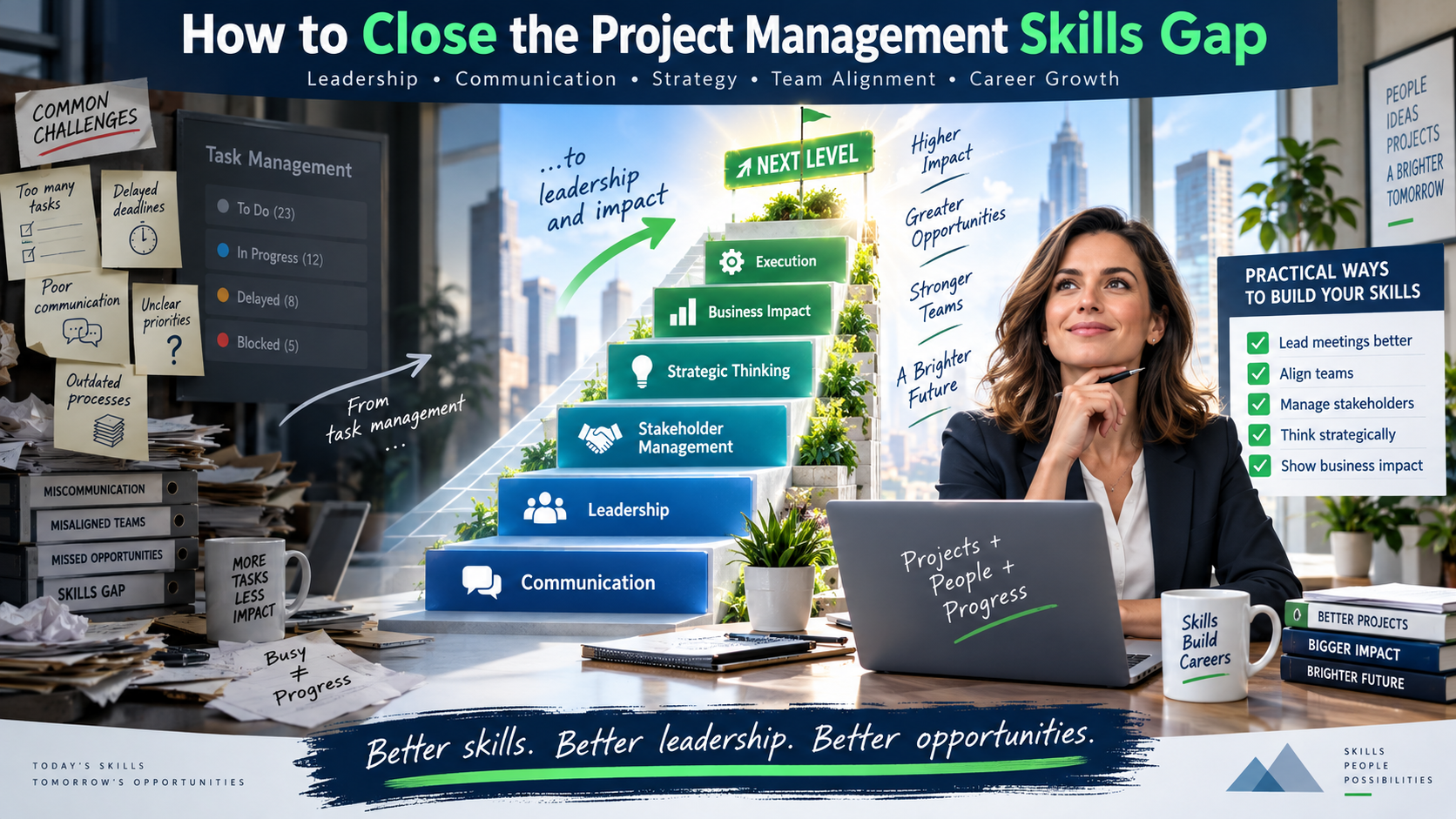
Deliberately Practise the Non-Technical Skills
- Volunteer to present project business cases directly to sponsors or executives, not just status updates.
- Ask for feedback specifically on influence and communication, not just delivery metrics.
Build Business and Financial Literacy
- Learn to read a basic P&L and connect your project’s outcomes to it in plain language.
- Practise explaining project value in one or two sentences a non-technical executive would immediately understand.
Seek Ambiguous, Non-Standard Work Deliberately
- Put your hand up for the messy, undefined project rather than the well-scoped one.
- Treat unclear situations as the actual skill-building ground, not something to avoid until “more experienced.”
Where This Shows Up Across Australia
The pattern is consistent nationally: PMs who plateau tend to over-index on process and certification alone, while PMs who advance combine that same technical base with visible business and stakeholder influence.
| City | Common Plateau Point | What Tends to Break the Ceiling |
| Sydney | Senior Project Manager | Executive stakeholder exposure |
| Melbourne | Project Manager (mid-level) | Business case ownership |
| Brisbane | Project Coordinator/Officer | PRINCE2/PMP plus visible delivery record |
| Perth | Senior Project Manager | Cross-functional program exposure |
| Adelaide | Project Manager (mid-level) | Stakeholder influence, not just reporting |
| Canberra | Project Officer (government) | Governance fluency plus strategic framing |
Where to Build These Skills Deliberately
The technical foundation still matters it’s the credibility platform everything else is built on. PRINCE2 Practitioner and PMP Certification both build that base, while Agile Scrum Master adds the adaptive, ambiguity-tolerant skill set that increasingly separates senior PMs from mid-level ones. For a side-by-side comparison of the two major certification paths, see PMP vs PRINCE2: Which Project Management Certification Is Better in Australia? Related reading: Agile vs Traditional Project Management, Project Manager Salary Australia, and Project Coordinator to Project Manager: A Practical Career Roadmap. The full course catalogue is available at logitrain.com.au.
Frequently Asked Questions
Why do some project managers get promoted faster than others with the same certification?
Certification signals technical competence, but promotion decisions weigh stakeholder influence, business acumen, and comfort with ambiguity just as heavily — skills that certification study rarely drills directly.
What skills should I build to move from Project Manager to Senior Project Manager?
Focus on business case ownership, direct executive communication, and taking on ambiguous or undefined work rather than only well-scoped projects.
Is PMP or PRINCE2 enough on its own to get promoted?
Both are strong technical foundations and are usually necessary, but rarely sufficient alone pairing certification with deliberate practice in stakeholder influence and business framing is what tends to break the plateau.
Final Thought
The project management skills gap isn’t a talent gap it’s a practice gap. The technical skills get drilled through certification; the leadership and strategic skills get practised only if you go looking for the opportunities to practise them. If you want the technical foundation locked in while you build the rest, explore Logitrain’s PRINCE2 and PMP training and start closing the gap deliberately.