


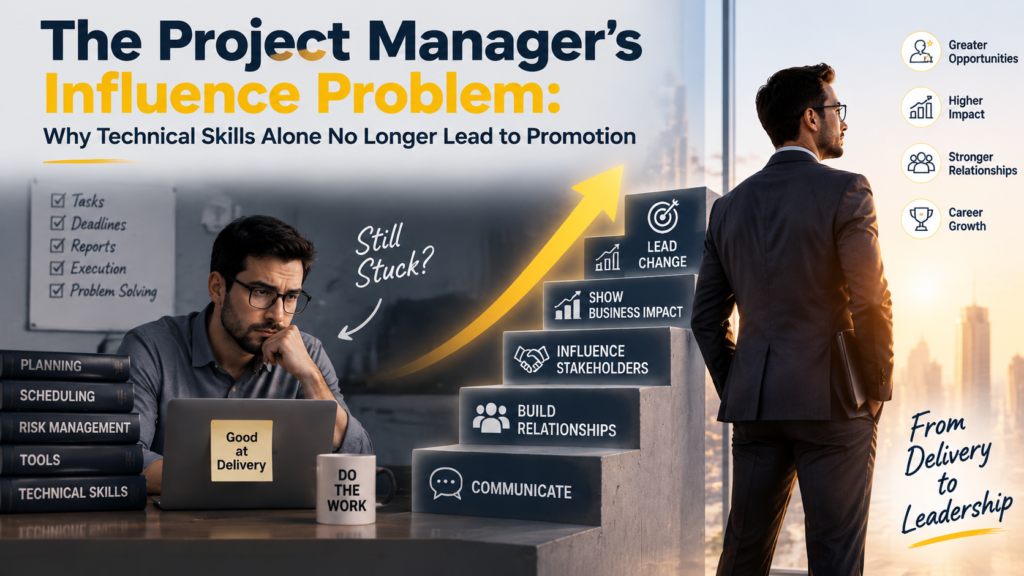
Plenty of project managers run a flawless schedule, keep the budget on track, and manage risk registers meticulously and still get passed over for promotion. Why technical skills alone no longer lead to promotion comes down to a simple shift: organisations don’t just need projects delivered anymore, they need someone who can influence people who don’t report to them. This article breaks down exactly what that influence gap looks like, and how structured project management courses help close it.
Why Technical Skills Alone No Longer Lead to Promotion
Scheduling, budgeting, risk registers and status reporting are now baseline expectations, not differentiators every experienced PM is assumed to have them. What separates a PM who gets promoted into a senior or programme-level role is the ability to influence outcomes across a business, often without any formal authority over the people involved. That’s the real promotion filter, and it’s rarely taught alongside the technical fundamentals.
The Project Manager’s Influence Problem, Explained
Most project managers have authority over a project plan, but almost none have direct authority over the stakeholders, department heads or executives whose cooperation the project actually depends on. Success requires influencing people who don’t answer to you and that’s a fundamentally different skill from managing a schedule.
The Influence Skills That Actually Get PMs Promoted
1. Managing Without Direct Authority
Senior PMs get things done through relationships and credibility, not job titles. Learning to negotiate priorities, trade favours, and build genuine goodwill across teams is what makes stakeholders show up for your project even when it isn’t their top priority.
2. Executive-Level Communication
A status report full of task percentages means nothing to an executive sponsor. PMs who get promoted learn to translate project detail into business impact risk, cost, timeline consequences in language a senior stakeholder can act on in thirty seconds.
3. Reading the Organisational Politics
Every organisation has an informal structure alongside the formal one who actually influences decisions, whose support quietly unlocks resources, which conflicts are really about competing priorities rather than the stated issue. PMs who understand this move projects forward faster than those who only follow the org chart.
4. Conflict Resolution That Preserves Relationships
Escalating every disagreement up the chain gets a project manager labelled as difficult to work with. Resolving conflict directly, calmly, and in a way that preserves the relationship is a skill that senior leadership notices and rewards.
5. Negotiation Beyond Scope and Budget
Negotiating a vendor contract is one skill. Negotiating competing priorities between two department heads who both think their initiative should come first is a different, much harder skill and it’s exactly the kind of situation that senior project and programme roles are built around.
How to Build These Influence Skills
These capabilities are rarely built by accident on the job they’re usually developed deliberately through structured training combined with real practice. Our AgilePM Foundation course builds the collaborative, stakeholder-centred mindset that underpins influence in Agile environments, while the AgilePM Practitioner course goes further into applying that mindset practically managing shifting priorities, competing stakeholder demands, and governance conversations in real project settings.
Practical Ways to Build Influence Now
- Practise summarising a project update in two sentences of business impact, not task status
- Map out who actually influences decisions on your project, beyond the formal org chart
- Handle one difficult stakeholder conversation directly instead of escalating it
- Ask a mentor or senior PM to review how you communicate risk to executives

What Industry Bodies Say About This Shift
The Project Management Institute (PMI) has increasingly emphasised leadership, communication and stakeholder skills as core to the modern PM role, not an optional extra layered on top of technical delivery. Similarly, the Association for Project Management (APM) highlights that senior project professionals are distinguished as much by their ability to influence and lead through uncertainty as by their technical planning competence reinforcing that this shift isn’t a passing trend, it’s the new baseline for advancement.
Where This Matters Most Across Australia
We see project managers building these influence skills consistently through our courses across Melbourne, Sydney, Brisbane, Perth, Adelaide and Canberra, where organisations across construction, IT, government and finance are actively promoting PMs who can demonstrate stakeholder influence, not just technical delivery.
Common Mistakes That Keep PMs Stuck at the Same Level
- Assuming more certifications alone will lead to promotion without building influence skills
- Escalating every stakeholder conflict instead of resolving it directly
- Reporting status in task percentages instead of business impact
- Ignoring the informal organisational politics that actually move decisions
- Waiting to be given more authority instead of building influence without it
Final Thoughts
If you’ve been asking why technical skills alone no longer lead to promotion, the honest answer is that influence has become the real differentiator at senior levels and it’s a skill you can deliberately build. Start with structured training through our AgilePM courses, then practise stakeholder communication and negotiation in every project you run. Contact our team to find the right course for where you are in your career.