


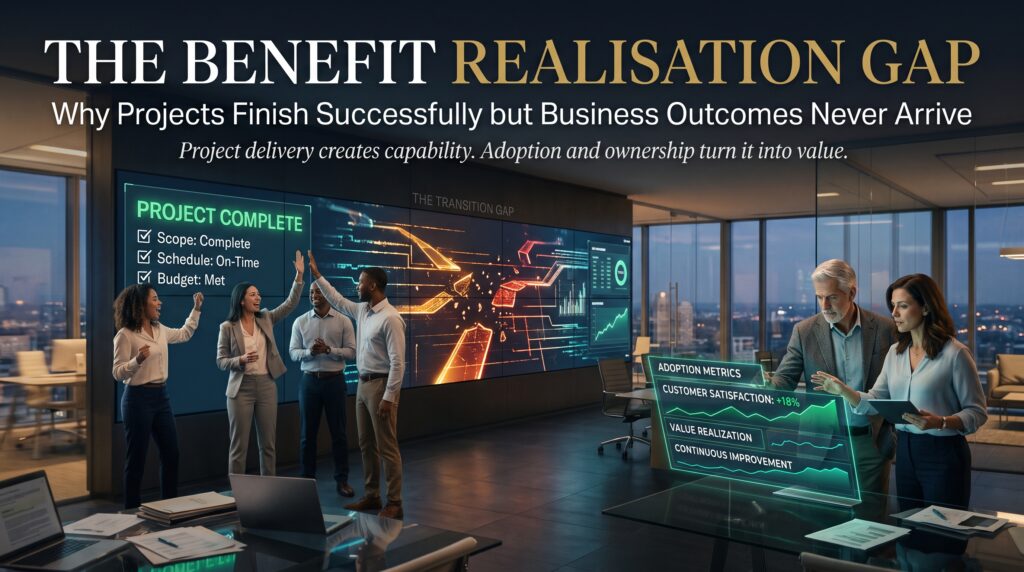
The benefit realisation gap is the uncomfortable distance between a project that closes on time and a business that actually changes. The steering committee applauds, the final report is signed off, the project manager moves on to the next job, and six months later nobody can point to the saving, the growth or the efficiency that justified the funding in the first place. Across Sydney, Melbourne, Brisbane, Perth, Adelaide and Canberra, this pattern shows up in banks, hospitals, councils, telcos and software teams alike. The project was delivered. The outcome never arrived.
If you manage projects, sponsor them, or are building a career around them, understanding it is one of the most practical things you can do. It explains why “green” status reports can sit alongside disappointed executives, and it points to specific habits that close the distance. This guide walks through what the gap is, why it keeps happening, how to spot it early, and how certified project managers are trained to prevent it.
What Is the Benefit Realisation Gap in Project Management?
In simple terms, the benefit realisation gap is the difference between what a project was approved to achieve and what the organisation actually gains after delivery. Benefits realisation management, a discipline recognised by the Project Management Institute (PMI) and built into frameworks such as PRINCE2 and the Association for Project Management’s body of knowledge, treats benefits as the whole reason a project exists. You can read a neutral overview of the concept on Wikipedia’s benefits realisation management page.
The gap appears because most projects are measured on delivery, not on value. Scope, schedule and budget are easy to track, so they become the scorecard. Revenue uplift, reduced handling time, fewer complaints or lower compliance risk are harder to track, sit outside the project plan, and usually only appear months after the team has disbanded. When nobody owns those measures, the gap quietly widens.
Outputs, Outcomes and Benefits: Where Projects Lose the Thread
A lot of confusion comes from mixing up three different things. An output is what the project produces, such as a new CRM, a rebuilt website or a redesigned process. An outcome is the change in behaviour that follows, such as sales staff actually using the CRM. A benefit is the measurable value the business gets from that change, such as shorter sales cycles or higher retention. The table below shows how a typical project loses the thread.
| Project | Output (delivered) | Outcome (behaviour change) | Benefit (business value) |
| CRM rollout | New CRM live on time | Sales team logs every deal in it | Shorter sales cycle, better forecasting |
| Website rebuild | New site launched | Customers use self-service pages | Fewer support calls, higher conversions |
| Process automation | Workflow tool deployed | Staff stop using spreadsheets | Lower cost per transaction |
| Compliance program | Policies published | Teams follow new controls | Reduced audit findings and risk |
Most projects stop at the first column. The gap lives in the other two.
Why Projects Succeed but Business Outcomes Never Arrive
There is rarely one villain. In practice it is the result of several ordinary habits that compound over time.

1. Benefits are written once and never revisited
The business case is often prepared to win approval, then filed away. Benefits claimed in that document are optimistic, loosely defined and rarely tested. By the time delivery starts, scope has shifted, but nobody updates the expected benefits to match. This is the most common root of the problem.
2. Nobody owns the benefit after go-live
Project managers own delivery. Operational managers own the business. Benefits fall between the two. Unless a named benefit owner is accountable for the number moving, the project closes and the responsibility evaporates.
3. Change management is treated as training
A one-hour webinar is not adoption. When people are not helped to change how they work, the new system sits beside the old habits and the promised outcome never appears. Weak adoption is a direct driver of the gap, and it is closely related to the commitment problems explored in our post on why projects fail when people agree but do not commit.
4. Success is declared too early
Closing a project at go-live is convenient, but benefits usually take months to show. If the formal review happens before the data exists, the organisation never learns whether the investment paid off.
5. Measures are vague or missing
“Improve customer experience” is not a benefit. “Reduce average call handling time from nine minutes to seven by June” is. Without a baseline and a target, nobody can prove whether the benefit realisation gap has closed.
Warning Signs of a Benefit Realisation Gap
You can often spot the gap long before the project ends. Watch for these signals:
- The business case has not been opened since the project was approved.
- Status reports talk about milestones and budget but never mention benefits.
- No one can name the person accountable for the expected outcome.
- End users are surprised by the change in the final weeks.
- The project closes with no plan to measure results after go-live.
- Executives ask “what did we actually get?” and the answers differ by person.
If three or more of these sound familiar, run a structured review. Our guide on project health checks shows how to assess scope, schedule, budget, risk, stakeholders and team before a project drifts too far.
How to Close the Benefit Realisation Gap: A Practical Approach
Closing the benefit realisation gap does not require a new methodology. It requires a handful of disciplined habits applied consistently from the first week.
- Define benefits in measurable terms. Write each benefit with a baseline, a target, a date and a measurement method.
- Name a benefit owner. Choose a senior business leader, not the project manager, who is accountable for the result.
- Build a benefits map. Link every deliverable to the outcome it enables and the benefit it supports. Remove deliverables that connect to nothing.
- Plan adoption early. Budget time and money for communication, coaching and support, not only for build and test.
- Track benefits in the same governance forum as cost and schedule. If benefits are not on the agenda, they will not be managed.
- Keep the project open for a benefits review. Schedule post-implementation reviews at three, six and twelve months.
- Feed lessons back. Record what worked so the next business case is more honest and the next benefit realisation gap is smaller.
How PRINCE2, PMP and Agile Address the Benefit Realisation Gap
Every major framework has something to say about value, but they approach it differently, which is why many professionals study more than one.
PRINCE2 is the most explicit. Its business case theme and post-project benefits reviews are designed to keep value visible from start to finish. If you work in government or large enterprise, PRINCE2 Foundation training and PRINCE2 Practitioner certification teach you to build and maintain a living business case. PMP, covered in the PMP certification course, places strong emphasis on business acumen, a skill the PMI describes in its Talent Triangle and discusses in research such as the PMI Pulse of the Profession. Agile approaches, taught in the Agile Scrum Master course, shorten the feedback loop by delivering value in small increments, which exposes the gap early instead of at the end.
Not sure which path suits you? Our comparison of PMP vs PRINCE2 in Australia and the article on Agile vs traditional project management break down the trade-offs in plain language.
Benefit Realisation Gap Across Australian Cities
Demand for benefits-focused project managers is strongest wherever large transformation programs run. The table gives a quick view of where the benefit realisation gap tends to hurt most, and where certified professionals are in demand.
| City | Typical project environment | Where the gap shows up |
| Sydney | Banking, fintech, consulting, large enterprise IT | Multi-year programs where benefits are lost between phases |
| Melbourne | Government, health, telecommunications, education | Digital service projects delivered but not adopted |
| Brisbane | Infrastructure, resources, state government | Capital projects that finish without operational handover |
| Perth | Mining, energy, engineering, logistics | Technology upgrades with weak benefit ownership |
| Adelaide | Defence, advanced manufacturing, public sector | Long programs with limited post-implementation review |
| Canberra | Federal government and agencies | Policy and system changes where outcomes are hard to measure |
Whether you are a project coordinator in Brisbane or a program lead in Canberra, the skills that close it travel well between industries, which is one reason project management training in Australia remains a reliable career investment.
Why Employers Value Project Managers Who Close the Benefit Realisation Gap
Hiring managers are tired of hearing that projects were “delivered successfully” while the business case quietly collapses. Candidates who can show how they defined benefits, tracked them after go-live and corrected course are far more persuasive than those who list only budgets and timelines. That is also why this skill appears so often in discussions of the project management skills gap and in conversations about project manager salary in Australia. Professionals who connect delivery to business value tend to move into senior, program and PMO roles faster.
Structured training helps. A recognised certification gives you shared language, tested templates and a framework you can defend in front of a sponsor. If you want a guided path, explore the live online courses at Project Management Courses Online or see the wider training options from Logitrain.
Frequently Asked Questions About the Benefit Realisation Gap
What causes the benefit realisation gap?
The benefit realisation gap is usually caused by vague benefits, no named benefit owner, weak change management and closing projects before results can be measured.
How do you measure benefit realisation?
Set a baseline and a target for each benefit, assign an owner, and review the measure at agreed intervals after go-live, typically three, six and twelve months.
Is benefits realisation covered in PMP and PRINCE2?
Yes. PRINCE2 builds benefits into its business case theme and post-project reviews, while PMP covers value delivery and business acumen. Both help reduce it.
Who is responsible for benefits after a project closes?
A senior business owner, often the sponsor or an operational executive, should be accountable. The project manager supports, but does not usually own, long-term benefits.
Can Agile projects have a benefit realisation gap?
They can, but frequent releases and feedback make it easier to notice early and adjust before large amounts of money are spent.
Final Thoughts: Deliver the Outcome, Not Just the Project
A project that finishes on time and on budget but changes nothing has not succeeded. It has simply ended. The gap is not a mystery or a bad-luck event; it is the predictable result of treating delivery as the finish line. Define benefits clearly, give them an owner, plan for adoption and keep measuring after go-live, and the gap starts to close.
Ready to build these skills? Browse the PRINCE2 Foundation, PMP certification and Agile Scrum Master courses on projectmanagementcoursesonline.au and take your next project from “delivered” to “valuable”.