


Project manager promotion is supposed to be the natural reward for delivering well. So why do so many of the best delivery people stay at the same level for years?
The answer is an uncomfortable one. It’s called the project success trap: the better you deliver, the more your organisation needs you exactly where you are. You become the safe pair of hands, the person who gets the difficult project over the line. And safe pairs of hands are very hard to give up.
This guide explains how the trap works, the four walls that keep good project managers stuck, and a practical way to build a case for the next role. It’s written for project coordinators, project managers and team leaders across Australia, from Sydney, Melbourne, Brisbane, Perth, Adelaide or Canberra.
What Is the Project Success Trap?
Imagine you’ve delivered four projects in a row, on time and on budget. Leadership trusts you. The next risky initiative lands on your desk, and the one after that. Each win makes you more valuable as a deliverer and, paradoxically, less likely to be moved.
Your manager isn’t acting out of malice. They’re protecting results. If you’re promoted, who delivers the next difficult project? Unless there’s a ready successor, the safest decision is to keep you where you are and offer a thank-you and a modest raise.
That’s why project manager promotion rarely arrives automatically. It has to be earned in a different way from the way you earn praise.
The Four Walls That Block Project Manager Promotion
Wall 1: The reliability wall
Dependable people get dependable work. That sounds good until you realise the work never changes. If every assignment looks like the last one, you’re collecting repetition, not growth.
Wall 2: The output wall
Most project managers are judged on whether the project was on time and on budget. Those are outputs. Promotion decisions lean on outcomes: did the business get the value it wanted, and was this the right project in the first place?
Wall 3: The scope wall
You manage what you’re handed. Senior roles shape what gets chosen. If you’re only ever involved after the decision has been made, nobody sees your judgement at the point where it counts, and that quietly blocks project manager promotion.
Wall 4: The identity wall
“I’m a doer” is a proud identity and a limiting one. Leaders spend their days on trade-offs, priorities and people. If you still see yourself mainly as the person who makes things happen, others will too.
How Promotion Panels Really See Good Delivery
When a panel considers a project manager promotion, strong delivery is the starting line, not the finish. They’re usually asking a second, quieter set of questions:
- Can this person choose the right work, not only do the work well?
- Can they influence senior people who don’t report to them?
- Do they understand the commercial side: value, cost, risk and trade-offs?
- Do they develop others, or does everything depend on them?
- Can they handle ambiguity, where there’s no clear plan to follow?
- Is there a successor who can take over their current work?
Notice that none of those questions is “Do they deliver well?” That’s assumed. The panel wants evidence of the next level, and the trap makes that evidence hard to produce unless you create it on purpose.
How to Escape the Trap and Win a Project Manager Promotion
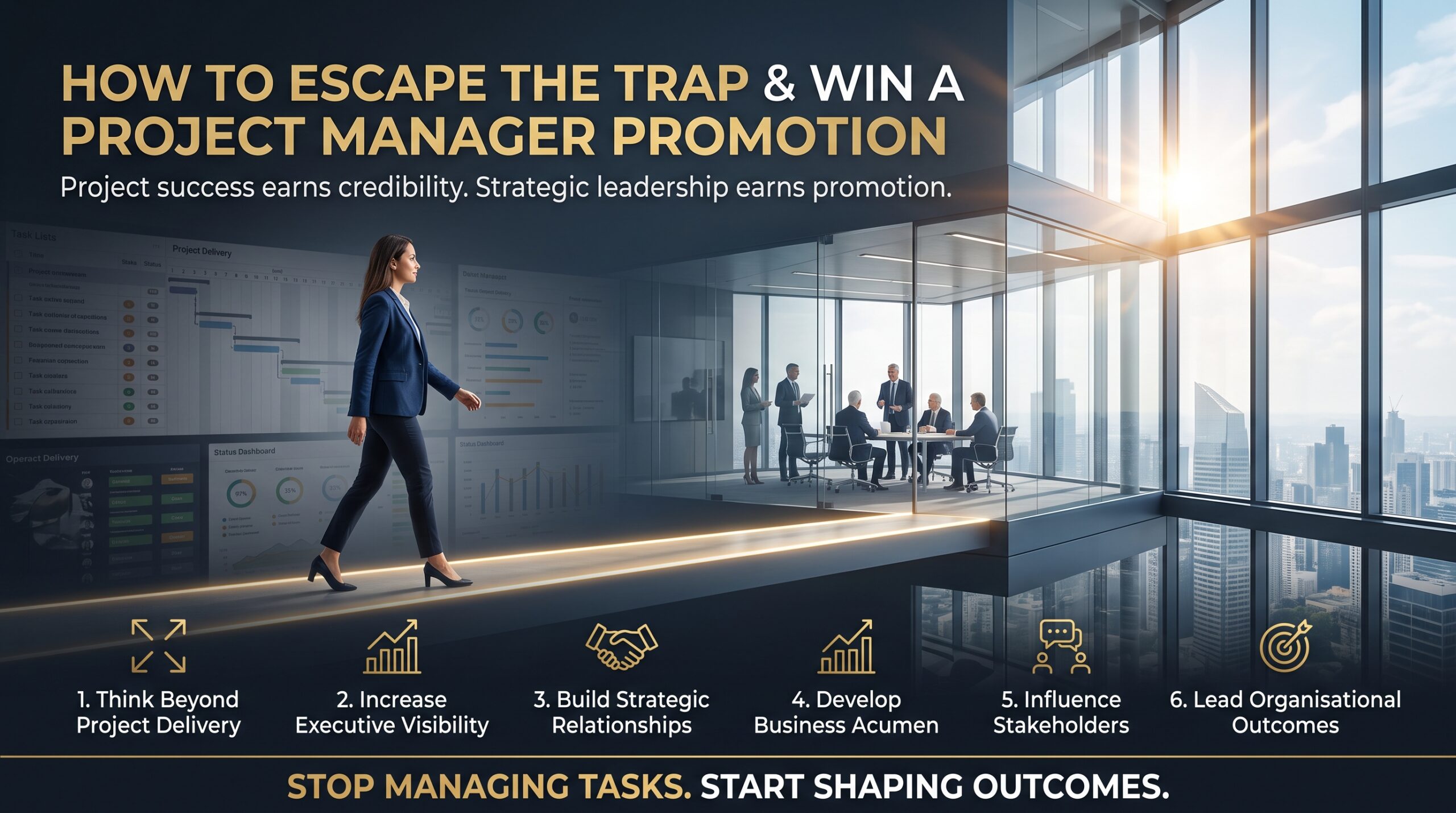
1. Swap output language for outcome language
Stop reporting “delivered on time”. Start reporting “reduced processing time by two days, which lets the team handle more customers”. Outcomes show you understand why the project existed.
2. Get involved before the project starts
Ask to help with the business case, the benefits and the options analysis. Even a small contribution shows you can shape decisions rather than just execute them.
3. Build your own successor
The fastest route to project manager promotion is to make yourself replaceable. Coach a coordinator, document your approach and hand over real responsibility. Your manager’s biggest objection disappears.
4. Take a stretch assignment on purpose
Choose one piece of work that’s bigger, messier or more political than usual: a cross-team initiative, a troubled project, a vendor negotiation. It proves range.
5. Move up the stack
Programs, portfolios and PMO roles sit above individual projects. Spend time understanding how priorities are set and how benefits are tracked. That’s the language of the next role.
6. Make your case in writing
Don’t rely on your manager remembering your wins. Keep a simple record and bring it to every review. That’s the idea behind the template below.
Build Your Project Manager Promotion Case: A One-Page Template
Before your next review, write one page covering these items. It takes an hour and changes the conversation.
- Your current scope. Team size, budget, number of stakeholders and the level you operate at today.
- Three outcomes, not outputs. What changed for the business because of your work?
- Two decisions you shaped. Where did your judgement alter the direction of a project?
- People you’ve developed. Who can now do something they couldn’t before?
- Evidence of next-level work. Stretch assignments, senior stakeholders you’ve managed, process improvements you led.
- Your specific ask. Name the role, the timeframe and what support you need to get there.
If you want a wider look at the barriers, read our companion guide on project management career growth. It covers sponsor relationships, visibility and a 90-day plan that pairs well with this template.
Courses and Credentials That Support Project Manager Promotion
Credentials won’t replace results, but the right one fills a gap that project manager promotion panels notice. Agile and hybrid delivery are now common expectations on many programs, so a recognised qualification helps. The AgilePM Foundation course gives you the framework and vocabulary, and the AgilePM Practitioner course shows you can tailor it to real projects, which is the kind of judgement senior roles require.
You can compare every option on the project management courses page, and choose live online, in-house or city-based training for Sydney, Melbourne, Brisbane, Perth, Adelaide or Canberra. See the locations page for the full list. Another view of the training landscape is available in this project management course overview.
Look beyond courses, too. The Project Management Institute and the Australian Institute of Project Management offer standards, events and networking, SEEK Career Advice publishes general guidance on career moves, and Jobs and Skills Australia tracks workforce trends.
Project Manager Promotion FAQs
Why am I stuck as a project manager when my projects always succeed?
Project manager promotion often stalls because your delivery record has made you hard to replace. Build a successor, show outcome-level thinking and bring a written case for the next role.
How long does a project manager promotion usually take?
There’s no fixed timeline. It depends on the organisation, the size of the projects you’ve led and whether you can show next-level evidence.
Do I need a certification to be promoted?
Not always, but a relevant credential can fill a skills gap and signal readiness. The FAQs page explains course formats and entry requirements.
Is changing employers faster than waiting for an internal promotion?
Sometimes. A new employer sees your record without the “we need you here” effect. But the evidence of next-level work will still decide the outcome, so build it either way.
Can a project manager move into program or PMO roles?
Yes. Experience with benefits, governance and multi-project coordination, plus recognised training, makes the transition easier.
Final Thoughts: Turn Delivery Into Direction
Great delivery got you here. Direction, judgement and leadership will get you further. A project manager promotion happens when the business can picture you in the bigger role, and when it’s safe to move you because someone else can step in.
Pick one step from this article and do it this week. If you’d like help choosing a course, contact our team or call 1300 649 299. You can also read more about us or browse the blog for more career guidance.